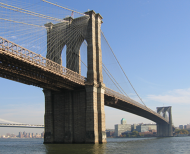
Brooklyn Bridge Opens: America's Longest Suspension Span
Fourteen years of construction, 27 deaths, and a span of 1,595 feet connected two cities that would soon become one. The Brooklyn Bridge opened to traffic on May 24, 1883, stretching across the East River between Manhattan and Brooklyn as the longest suspension bridge in the world and one of the great engineering achievements of the nineteenth century. Designer John Augustus Roebling never saw it finished. He died of tetanus in 1869 after a ferry crushed his foot during site surveys. His son Washington Roebling took over as chief engineer but was crippled by caisson disease (decompression sickness) from working in the underwater foundations. For the last eleven years of construction, Washington directed the project from his Brooklyn apartment, watching through a telescope while his wife Emily relayed instructions to the work site. The bridge's construction demanded innovations that had never been attempted at this scale. Workers excavated foundations inside pneumatic caissons, pressurized wooden boxes sunk to the riverbed, where temperatures exceeded 100 degrees and the risk of fire and blowouts was constant. The steel cables, a first for suspension bridge design, were manufactured on-site by spinning individual wires across the towers. Opening day drew an estimated 150,000 pedestrians and 1,800 vehicles. President Chester Arthur and New York Governor Grover Cleveland walked across together. Within a week, a panic on the pedestrian promenade killed 12 people in a stampede when someone shouted that the bridge was collapsing. The Brooklyn Bridge did not merely connect two land masses. It demonstrated that industrial engineering could reshape geography, and its Gothic stone towers became symbols of American ambition that architects and engineers still study and tourists still photograph 140 years later.
May 24, 1883
143 years ago
Key Figures & Places

What Else Happened on May 24
They caught him hunting when the messengers arrived. Henry the Fowler was setting bird traps in the Harz Mountains—literally fowling—when Saxon nobles found him…
The Fifth Crusade departed Acre for the Nile Delta, aiming to conquer Egypt and trade its territory for Jerusalem. This strategic gamble forced the Ayyubid Sult…
Magnus Ladulås received the Swedish crown at Uppsala Cathedral, solidifying his grip on power after a bitter civil war against his brothers. By formalizing his …
They dressed a ten-year-old baker's son in royal robes and called him Edward VI. Lambert Simnel had probably never held a sword before May 24, 1487, when Irish …
Lambert Simnel received a crown in Dublin as the Yorkist pretender King Edward VI, challenging the newly established Tudor dynasty. This audacious coronation fo…
The king brought the daggers himself. Erik XIV of Sweden, twenty-four years old and spiraling into paranoid delusion, personally stabbed nobleman Nils Sture in …
Talk to History
Have a conversation with historical figures who witnessed this era. Ask questions, explore perspectives, and bring history to life.