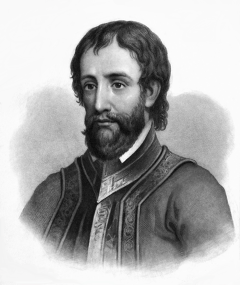
De Soto Discovers the Mississippi River
Hernando de Soto and his expedition stumbled upon the Mississippi River in May 1541, near present-day Memphis, Tennessee, and the Spanish conquistador saw not a geographic wonder but an obstacle. De Soto had spent two years marching through the American Southeast searching for gold and silver comparable to what Cortes had found in Mexico and Pizarro in Peru. He had found none, and the massive river blocking his westward path was just another disappointment in a journey defined by suffering. De Soto's expedition had left Havana in May 1539 with roughly 600 soldiers, 200 horses, and a herd of pigs that would serve as mobile provisions. They landed near Tampa Bay and marched north and west through territories that are now Florida, Georgia, the Carolinas, Tennessee, Alabama, and Mississippi. The journey was characterized by violent confrontations with Indigenous nations, the enslavement of native people as porters and guides, and the spread of European diseases that devastated communities the expedition passed through. The expedition reached the Mississippi sometime in May 1541, though the exact date is uncertain because the Spaniards' journals were imprecise about chronology. De Soto named the river "Rio de Espiritu Santo" and spent a month building barges to ferry his force across. Indigenous populations along the river were large and organized, occupying mound-building civilizations that the Spanish described with grudging respect. Once across, de Soto spent another year wandering through present-day Arkansas, Oklahoma, and Texas, still searching for wealthy civilizations to conquer. He found none. Disease, desertion, and combat losses reduced his force by more than half. De Soto himself fell ill with a fever, probably malaria, and died on the banks of the Mississippi on May 21, 1542. His men weighted his body with sand and sank it in the river to prevent Indigenous people from discovering that their seemingly invincible leader was mortal. The surviving 300 members of the expedition built boats and floated down the Mississippi to the Gulf of Mexico, eventually reaching Spanish settlements in Mexico. De Soto's three-year odyssey produced no wealth and established no colonies, but the diseases his expedition introduced killed an estimated 75 to 90 percent of the region's Indigenous population within a century.
May 8, 1541
485 years ago
Key Figures & Places
What Else Happened on May 8
The Zhi family thought they'd won when they flooded Jinyang's walls—until the Zhao and Wei families switched sides mid-siege and turned those same waters agains…
The emperor who famously cared more about his chickens than his empire signed tax relief for seven Italian provinces in 413—after the Visigoths had already burn…
The bishops who walked into Toledo that May carried weapons under their robes. Visigothic Arianism had ruled Spain for two centuries—father and son weren't the …
King Reccared I convened the Third Council of Toledo to formally renounce his Arian faith in favor of Nicene Christianity. This conversion unified the Visigothi…
King Edward III and King John II halted the Hundred Years' War by signing the Treaty of Brétigny, granting England sovereignty over vast swathes of southwestern…
She asked for death and got sixteen visions instead. Julian of Norwich, thirty years old and desperately ill in May 1373, received last rites from her priest. T…
Talk to History
Have a conversation with historical figures who witnessed this era. Ask questions, explore perspectives, and bring history to life.