
Sitting Bull Fleeing West: Lakota Seek Safety in Canada
Sitting Bull crossed the international boundary into Saskatchewan with roughly 5,000 Lakota people in May 1877, and the greatest military leader the Plains nations had produced became a refugee. The man whose coalition had destroyed Custer's command at Little Bighorn less than a year earlier chose exile over surrender, leading his followers north into the land they called "Grandmother's Country" after Queen Victoria. The flight followed months of relentless pursuit by Colonel Nelson Miles and the U.S. Army's winter campaign across Montana Territory. After Little Bighorn, the army adopted a strategy of attrition, attacking Lakota and Cheyenne camps in freezing weather, destroying food stores and horse herds, and forcing band after band to surrender. Crazy Horse gave up in May 1877. Sitting Bull, unwilling to accept reservation life, gathered those who refused to submit and moved north. The Canadian government, through the North-West Mounted Police, assigned Major James Moresby Walsh to manage the situation. Walsh developed an unlikely respect for Sitting Bull and advocated for the Lakota's right to remain. The Canadian position was legally precarious: Britain's territory had no obligation to shelter American fugitives, but the Lakota had committed no crime under Canadian law and had historical ties to the northern plains. Life in exile was brutal. The buffalo herds that the Lakota depended on were rapidly disappearing on both sides of the border. Canadian authorities refused to provide rations or grant reservation land, viewing the American refugees as a temporary problem. Starvation became chronic. Smaller groups peeled away and returned south to surrender throughout 1878 and 1879. Sitting Bull held out longer than anyone. He finally crossed back into the United States and surrendered at Fort Buford, Dakota Territory, on July 19, 1881, with 186 followers, the last significant band of free Lakota. He told the commanding officer he wished to be remembered as "the last man of my tribe to surrender my rifle." The government sent him to the Standing Rock Reservation, where he was killed by Indian police in December 1890.
May 5, 1877
149 years ago
Key Figures & Places

Canada
Wikipedia
United States Army
Wikipedia
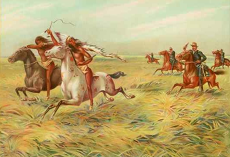
Indian Wars
Wikipedia
Colonel
Wikipedia
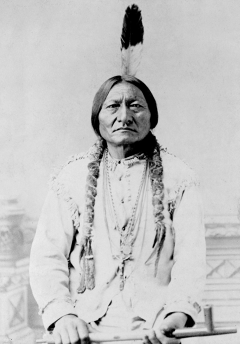
Sitting Bull
Wikipedia
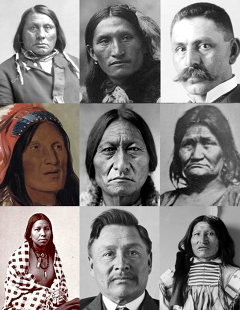
Lakota people
Wikipedia
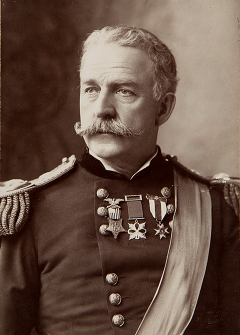
Nelson Miles
Wikipedia
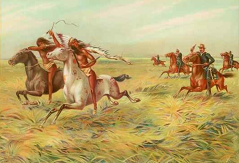
American Indian Wars
Wikipedia
Colonel
Wikipedia
American Indian Wars
Wikipedia
Sitting Bull
Wikipedia
Lakota people
Wikipedia
United States Army
Wikipedia
Colonel (United States)
Wikipedia
Nelson A. Miles
Wikipedia
What Else Happened on May 5
The emperor wasn't even there. Justinian I called 165 bishops to Constantinople to settle a theological fight that had been splitting Christians for a century—b…
Rebel barons formally renounced their allegiance to King John, declaring open war against the English crown. This bold act of defiance forced the King to negoti…
Kublai Khan won the Mongol throne by defeating his younger brother Ariq Böke in a four-year civil war that killed tens of thousands of their own people. The emp…
Christopher Columbus waded ashore at Discovery Bay, claiming the island of Jamaica for the Spanish Crown during his second voyage. This arrival initiated over a…
Christopher Columbus sighted the Jamaican coastline during his second voyage, claiming the island for the Spanish crown upon landing at Discovery Bay. This arri…
The invasion fleet sailed past Okinawa's coral reefs with three thousand samurai who'd never fought a naval campaign before. Shimazu Tadatsune wanted China trad…
Talk to History
Have a conversation with historical figures who witnessed this era. Ask questions, explore perspectives, and bring history to life.