Masada Falls to Rome: Jewish Fortress Defenders Choose Death
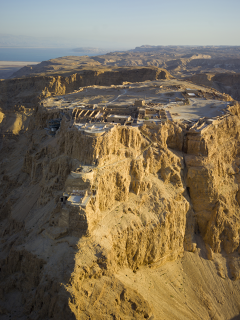
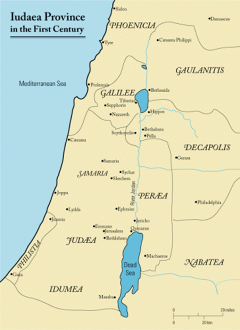
Nine hundred and sixty Jewish men, women, and children chose death over surrender atop the desert fortress of Masada in April 73 AD, ending a three-year siege by the Roman Tenth Legion. According to the historian Josephus, the defenders' leader Eleazar ben Ya'ir convinced them that suicide was preferable to the slavery and degradation that Roman capture guaranteed. Ten men were chosen by lot to kill the others, then one was selected to kill the remaining nine before taking his own life. When Roman soldiers finally breached the walls the next morning, they found the fortress silent. Masada rises 1,300 feet above the western shore of the Dead Sea, a flat-topped mesa with sheer cliffs on every side that Herod the Great had fortified as a royal refuge decades before the Jewish revolt. Herod's engineers had carved cisterns, storerooms, bathhouses, and palaces into the rock, creating a self-sufficient stronghold that could withstand prolonged siege. After Jerusalem fell and the Second Temple was destroyed in 70 AD, a group of Sicarii, radical Jewish rebels, seized Masada and held it as the last pocket of resistance against Rome. The Roman commander Flavius Silva surrounded the mesa with a wall of circumvallation and eight military camps, the remains of which are still visible from the summit. Unable to scale the cliffs, he ordered the construction of a massive earthen ramp up the western approach, a project that took months of labor by thousands of Jewish prisoners. When the ramp reached the fortress wall and a battering ram breached it, the defenders set fire to their possessions and carried out the mass suicide Josephus described. Josephus's account, the only historical source, presents interpretive challenges. He was a former Jewish commander who had defected to Rome, and his narrative served Roman propaganda interests while also attempting to honor Jewish courage. Modern archaeology has confirmed the siege works but found remains of only 28 people on the summit, far fewer than the 960 Josephus claimed. Regardless of the precise details, Masada became the most powerful symbol of Jewish resistance and national identity, and Israeli soldiers once took their oath of service on its summit with the pledge: "Masada shall not fall again."
April 16, 73
1953 years ago
Key Figures & Places
What Else Happened on April 16
Thutmose III didn't march through the narrow pass; he marched right past the enemy's flank, catching the Canaanite coalition completely off guard. Over a thousa…
Pharaoh Thutmose III squeezed through a narrow pass called Megiddo, risking his army to outflank a coalition of Canaanite kings. He didn't just win; he stripped…
Otho killed himself just three months after taking the throne. His troops had lost at Bedriacum to Vitellius, and the emperor decided a quick death was better t…
In 682, a man named Leo got voted in while sitting on a chair that wasn't even holy yet. He'd wait six weeks for his actual consecration, staring at empty stone…
Robert Guiscard captured the port of Bari, extinguishing five centuries of Byzantine authority in Southern Italy. This collapse forced the Eastern Roman Empire …
Stefan Dušan crowned himself Emperor of the Serbs and Greeks in Skopje, formalizing his control over a vast Balkan territory. By elevating his status to imperia…
Talk to History
Have a conversation with historical figures who witnessed this era. Ask questions, explore perspectives, and bring history to life.