

Katyn Graves Discovered: Soviet Atrocity Exposed
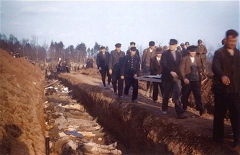
German soldiers digging field fortifications near Smolensk stumbled upon mass graves in the Katyn Forest in April 1943, uncovering rows of Polish military officers shot execution-style with their hands bound behind their backs. The discovery of approximately 4,400 bodies at this single site was the first evidence of a massacre the Soviet Union would deny for nearly fifty years. The total killing, carried out across multiple sites in April and May 1940, claimed roughly 22,000 Polish prisoners of war, police officers, intellectuals, and civil servants. The Soviet NKVD, acting on orders signed by Stalin and approved by the Politburo on March 5, 1940, had systematically executed Poland's educated and military elite. The victims were drawn from three prisoner-of-war camps at Kozelsk, Starobelsk, and Ostashkov. They were transported in small groups to execution sites, shot in the back of the head, and buried in carefully concealed mass graves. The operation was designed to eliminate the leadership class of a conquered nation, ensuring that a future independent Poland would lack the officers and professionals needed to rebuild. Nazi Germany seized on the discovery for propaganda purposes, inviting international observers and the Red Cross to examine the graves. The Soviet Union denied responsibility, claiming the Germans had committed the massacre during their 1941 invasion. When the Polish government-in-exile in London demanded an independent investigation, Stalin used their request as a pretext to sever diplomatic relations, a rupture that allowed him to install a Communist puppet government in postwar Poland. The truth remained officially suppressed for decades. Western governments, needing Soviet cooperation during the war and afterward, avoided pressing the issue. Soviet textbooks blamed the Nazis. Only in 1990 did Mikhail Gorbachev acknowledge Soviet responsibility, and in 2010 the Russian State Duma formally declared that Stalin and other Soviet leaders had ordered the massacre. For the families of the victims, the acknowledgment came half a century too late, but it closed one of the longest-running cover-ups of the twentieth century.
April 13, 1943
83 years ago
Key Figures & Places


What Else Happened on April 13
Bishop Otto of Bamberg refused to hand over the imperial regalia until Henry V promised to stop appointing bishops without papal consent. For three days, the em…
Saladin routed the Zengid forces at the Battle of the Horns of Hama, consolidating his control over Syria from Damascus to the Euphrates with only Aleppo remain…
Crusaders breached the walls of Constantinople, systematically looting the city’s vast wealth and sacred relics. This brutal sack shattered the Byzantine Empire…
A storm sank the French fleet, trapping King Louis IX in the muddy streets of Damietta while his soldiers starved. He didn't just lose; he paid a massive ransom…
Pope Alexander IV just signed Licet ecclesiae catholicae to force scattered hermits into one order. Hundreds of men stopped sleeping in caves and started sharin…
A Prussian knight stabbed a Polish envoy in 1454, sparking a fight for Kneiphof that didn't end until 1466. Ten thousand souls starved while Teutonic knights an…
Talk to History
Have a conversation with historical figures who witnessed this era. Ask questions, explore perspectives, and bring history to life.