
Buchenwald Liberated: America Uncovers the Holocaust's Horrors
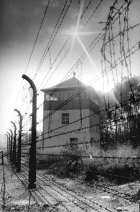
Twenty-one thousand walking skeletons greeted the American soldiers who crashed through the gates of Buchenwald on April 11, 1945. The inmates were barely alive, many weighing less than 80 pounds, their bodies ravaged by forced labor, starvation, and medical experiments. The stench of death hung over the camp like a permanent weather system. Troops of the 6th Armored Division found piles of emaciated corpses stacked near the crematorium. Buchenwald, established in 1937 on the wooded hills above Weimar, had been one of the largest concentration camps in Germany. Over its eight years of operation, an estimated 280,000 people were imprisoned there, including political dissidents, Jews, Roma, homosexuals, prisoners of war, and Jehovah's Witnesses. At least 56,000 died from execution, exhaustion, disease, and brutal medical experiments conducted by SS physicians. Hours before the Americans arrived, the camp's underground resistance network had seized control of watchtowers and captured over 100 SS guards as most of the German garrison fled. This organized resistance, led by a multinational committee of political prisoners, had spent years secretly stockpiling weapons and maintaining radio contact with advancing Allied forces. Among the survivors were Elie Wiesel, then sixteen years old, and hundreds of children the resistance had hidden from transport lists. General Dwight Eisenhower ordered every American soldier in the area to visit Buchenwald and nearby camps. He insisted on photographic documentation, writing to General George Marshall that the evidence should be preserved because he feared that someday people would claim the Holocaust never happened. Eisenhower's instinct proved grimly prescient. The liberation of Buchenwald became one of the defining moments of Allied victory, transforming abstract reports of Nazi atrocities into undeniable, witnessed reality.
April 11, 1945
81 years ago
Key Figures & Places
World War II
Wikipedia
Buchenwald
Wikipedia
concentration camp
Wikipedia
Buchenwald concentration camp
Wikipedia
World War II
Wikipedia
Buchenwald concentration camp
Wikipedia
Neumarkt in der Oberpfalz
Wikipedia
Geschichte der Stadt Neumarkt in der Oberpfalz
Wikipedia
Widerstand im KZ Buchenwald
Wikipedia
KZ Mittelbau-Dora
Wikipedia
Nordhausen
Wikipedia
Łódź
Wikipedia
Wartheland
Wikipedia
Deutsche Besetzung Polens 1939–1945
Wikipedia
Karl Litzmann
Wikipedia
Geschichte der Stadt Łódź
Wikipedia
What Else Happened on April 11
She handed him a crown he'd never asked for, then demanded he count every coin in the treasury before accepting. Anastasius didn't just inherit a throne; he inh…
King Bolesław II of Poland ordered the execution of Bishop Stanislaus of Kraków after a bitter dispute over land and the monarch's moral conduct. This act of vi…
Batu Khan’s Mongol forces crushed King Béla IV’s army at the Battle of Muhi, shattering the Hungarian military and leaving the kingdom defenseless against a bru…
Gaston de Foix led a Franco-Ferrarese army to a bloody victory over Papal-Spanish forces at Ravenna, the deadliest battle in Europe since antiquity, with over 1…
Gaston de Foix crushed the Spanish and Papal armies at the Battle of Ravenna, utilizing mobile field artillery to shatter enemy infantry formations. While the F…
They dug into the mud near Ceresole and didn't stop until the Spanish pikes shattered. Francis I's troops crushed 12,000 men, leaving a mountain of dead that sm…
Talk to History
Have a conversation with historical figures who witnessed this era. Ask questions, explore perspectives, and bring history to life.