

House of Wax Premieres: Cinema Enters the 3-D Era
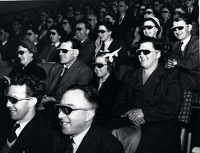
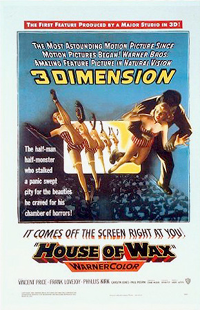
Warner Brothers released House of Wax in April 1953 as the first major studio feature film shot in the Natural Vision 3-D process, and audiences lined up around the block to watch Vincent Price terrorize them from what seemed like the other side of the screen. The film was also one of the first to use stereophonic sound, immersing viewers in a sensory experience that no television set could replicate. Warner Brothers was fighting for survival against the small screen, and 3-D was one of several weapons the studios deployed in the early 1950s to lure audiences back to theaters. The 3-D craze of the 1950s was driven by an existential crisis in the American film industry. Television had cut movie attendance from 90 million weekly in 1948 to 46 million by 1953, and studios were desperate for gimmicks that would differentiate theatrical exhibition from home viewing. Bwana Devil, a low-budget independent production, had demonstrated the commercial potential of 3-D in late 1952, grossing $5 million on a tiny budget. Warner Brothers saw the numbers and fast-tracked House of Wax, remaking their 1933 film Mystery of the Wax Museum with the new technology. Vincent Price starred as Professor Henry Jarrod, a wax sculptor whose partner destroys his museum for the insurance money, leaving Jarrod disfigured and deranged. He rebuilds his exhibit using the corpses of murdered victims, coated in wax. The role established Price as the preeminent horror actor of his generation, a position he would hold for three decades. Director Andre de Toth, who was blind in one eye and could not actually see the 3-D effects he was creating, nevertheless crafted set pieces specifically designed to exploit the format: a barker with a paddle ball, wax figures reaching toward the audience, and a climactic chase through the museum. The film grossed $23 million worldwide, making it the most commercially successful 3-D film ever produced and one of the biggest hits of 1953. The success triggered a wave of 3-D productions from every major studio. By 1954, however, audiences had grown tired of the format's limitations: the polarized glasses were uncomfortable, the dual-projector system produced alignment problems, and many films used the technology as a cheap gimmick rather than a storytelling tool. The 3-D boom collapsed as quickly as it had arrived, but it returned in waves: the 1980s, and again with Avatar in 2009.
April 9, 1953
73 years ago
Key Figures & Places

What Else Happened on April 9
A legion in Illyricum shouted "Severus Augustus!" before anyone else knew the old emperor was dead. They didn't wait for the Senate; they grabbed a sword and cl…
Sixteen legions marched out of Illyricum, not to defend the frontier, but to burn down the old guard. While Commodus lay dead in Rome, Severus's soldiers realiz…
Emperor Basiliscus issued the Enkyklikon on April 9, 475 AD, a circular letter to the bishops of the Byzantine Empire demanding their acceptance of the Monophys…
1,600 cavalrymen arrived, mostly Huns and Slavs with bows that could punch through Gothic armor. Belisarius didn't wait for supplies to fill his bellies; he str…
Mongol tumens crushed a coalition of Polish and German knights at the Battle of Liegnitz, securing a total tactical victory through superior mobility and feigne…
Stakes were literally underwater in 1288 when Tran forces drove sharp bamboo stakes into the riverbed of Bach Dang. The Yuan fleet, packed with war elephants an…
Talk to History
Have a conversation with historical figures who witnessed this era. Ask questions, explore perspectives, and bring history to life.