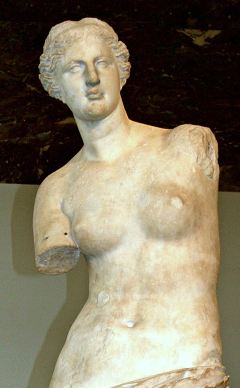
Venus de Milo Unearthed: Greece's Lost Masterpiece Resurfaces
A Greek farmer named Yorgos Kentrotas was digging in his field on the Aegean island of Melos in April 1820 when his shovel struck marble. He unearthed the upper half of a female statue of extraordinary beauty, then found the lower half nearby. French naval officer Olivier Voutier, who happened to be exploring ancient ruins on the island, recognized the find's significance immediately and alerted the French ambassador to the Ottoman Empire. What followed was a diplomatic scramble between France and the Ottoman authorities that nearly resulted in the statue being lost entirely. The Venus de Milo, as the statue became known, dates to approximately 130-100 BC, placing it in the Hellenistic period rather than the classical era that produced the Parthenon sculptures. The sculptor is believed to be Alexandros of Antioch, based on a fragmentary inscription found near the statue that was subsequently lost. The figure is slightly larger than life-size, standing approximately 6 feet 8 inches tall, and depicts Aphrodite (or possibly Amphitrite, the sea goddess) in a pose of casual, almost languid grace. Her missing arms have generated centuries of speculation; they were apparently already detached when Kentrotas found her. France acquired the statue through a combination of diplomatic pressure and cash payment to Ottoman officials, and the Marquis de Riviere presented it to King Louis XVIII in 1821. The timing was politically useful. France had been forced to return the Medici Venus to Italy after Napoleon's defeat, and the nation's cultural prestige demanded a replacement masterpiece. The Venus de Milo was immediately installed in the Louvre, where curators promoted it as a work rivaling or surpassing anything in Italian collections. The statue's fame grew steadily through the nineteenth century, aided by plaster casts distributed to museums and academies worldwide. Artists, critics, and philosophers debated its meaning, proportions, and the position of the missing arms. Some scholars proposed she had held a shield, an apple, or a mirror. Others suggested she was part of a sculptural group. The mystery of the arms paradoxically enhanced her appeal; the incompleteness invited imagination. The Venus de Milo remains in the Louvre, where she draws approximately 8 million visitors annually, second only to the Mona Lisa.
April 8, 1820
206 years ago
Key Figures & Places
What Else Happened on April 8
He didn't die in battle. Caracalla fell to a lone guard named Martialis, who stabbed him near Carrhae while the emperor was answering nature's call. The Praetor…
Siddhartha Gautama sat beneath a Bodhi tree in Bodh Gaya, in what is now northeastern India, and refused to move until he understood the nature of suffering. Ac…
A six-year-old boy named Chilperic died alongside his father in the quiet town of Blaye. King Charibert II and his infant son were cut down, likely by order of …
Abbasid forces crushed Ya'qub ibn al-Layth’s Saffarid army at the Battle of Dayr al-'Aqul, forcing a chaotic retreat down the Tigris. By halting the Saffarid ad…
Walkelin squeezed into a cathedral that still smelled of wet lime and sawdust. He'd spent fifteen years forcing laborers to haul stone from quarries miles away,…
An excommunication that lasted seven years for a man who already said he agreed with the Pope. Roger II of Sicily backed Anacletus II against Innocent II, then …
Talk to History
Have a conversation with historical figures who witnessed this era. Ask questions, explore perspectives, and bring history to life.