

NATO Founded: Twelve Nations Unite Against Soviet Threat
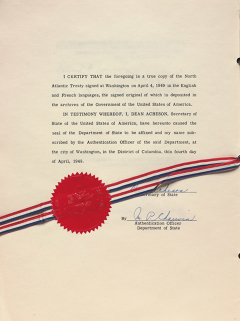
Twelve nations signed the North Atlantic Treaty on April 4, 1949, in Washington, D.C., creating the most powerful military alliance in history. The signatories were the United States, Canada, Britain, France, Belgium, the Netherlands, Luxembourg, Norway, Denmark, Iceland, Italy, and Portugal. The treaty's core commitment was Article 5: an armed attack against one member would be considered an attack against all. This collective defense clause was designed to deter Soviet aggression against Western Europe and to bind the United States permanently to European security. The alliance emerged from genuine fear. The Soviet Union had absorbed Eastern Europe, backed a communist coup in Czechoslovakia in February 1948, and blockaded West Berlin in June of that year. Western European nations felt vulnerable and doubted their ability to resist Soviet military power without American involvement. Britain's Foreign Secretary Ernest Bevin was the driving force behind the diplomatic effort, working with U.S. Secretary of State Dean Acheson and Canadian diplomat Lester Pearson to craft a treaty that Congress would accept. American participation was the critical question. The United States had never joined a peacetime military alliance, and many senators were reluctant to commit American forces to the defense of Europe. Senator Arthur Vandenberg, a former isolationist who had converted to internationalism, shepherded the treaty through the Senate, where it passed 82 to 13. President Truman signed the ratification on July 25, 1949, formally binding the United States to European defense for the first time in the nation's history. NATO's first Supreme Allied Commander, Dwight Eisenhower, established the military structure in 1951, building an integrated command system that placed European and American forces under unified control. The alliance initially had no standing forces; member nations contributed troops and equipment to a joint defense plan that existed primarily on paper. The Korean War in 1950 accelerated rearmament, and by the mid-1950s, NATO had substantial conventional and nuclear forces deployed across Western Europe. Article 5 was invoked for the first and only time on September 12, 2001, the day after the attacks on the World Trade Center and the Pentagon.
April 4, 1949
77 years ago
Key Figures & Places
What Else Happened on April 4
A laurel wreath that smelled of wet earth and crushed olive leaves. Agrippa Menenius Lanatus marched through Rome in 503 BC, not for grand strategy, but because…
A drone spotted a Russian convoy in a ravine just as dawn broke over Chasiv Yar. But the soldiers inside didn't see the trap closing; they only saw the mud and …
Fire roared through Luoyang's palaces, turning marble to dust. Dong Zhuo dragged the emperor east while his men burned every library and temple for weeks. Thous…
King Uneh Chan of Calakmul shattered the defenses of Palenque, launching a devastating assault that crippled the rival city-state’s political stability. This br…
Pulakeshin II didn't just win; he carved his victory into stone across a thousand miles of India's heartland in 619. Two kings stood on opposite banks of the Na…
King Louis the Pious seized Barcelona from the Moors after a grueling months-long siege, securing the Frankish Empire’s southern frontier. This victory establis…
Talk to History
Have a conversation with historical figures who witnessed this era. Ask questions, explore perspectives, and bring history to life.