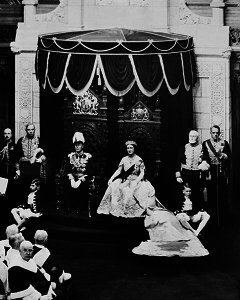
Canada Emerges: Dominion Formed Under British North America Act
Canada was not born from revolution but from negotiation, compromise, and a healthy fear of American expansion. On March 29, 1867, Queen Victoria gave Royal Assent to the British North America Act, uniting the provinces of Canada (Ontario and Quebec), New Brunswick, and Nova Scotia into the Dominion of Canada, effective July 1. The new nation governed itself domestically but left foreign policy, defense, and constitutional amendments in London's hands for another century. The driving force behind Confederation was not patriotic fervor but practical anxiety. The American Civil War had demonstrated the destructive power of a modern military, and British North Americans watched nervously as a million-strong Union army disbanded just across the border. Fenian raids by Irish-American nationalists into Canadian territory in 1866 underscored the vulnerability of disunited colonies. Meanwhile, Britain was eager to reduce its military obligations in North America. John A. Macdonald of Ontario and George-Etienne Cartier of Quebec led the coalition that hammered out the terms at conferences in Charlottetown, Quebec City, and London. The resulting federation balanced English Protestant and French Catholic interests through a bicameral parliament, guaranteed minority language and education rights, and distributed powers between federal and provincial governments. Prince Edward Island and Newfoundland initially refused to join; British Columbia was enticed in 1871 with the promise of a transcontinental railway. The BNA Act created one of the world's largest countries by area but left fundamental questions unresolved. Quebec's place within Confederation, Indigenous sovereignty, and the relationship with Britain would fuel political crises for the next 150 years. Canada did not gain full control over its own constitution until the patriation of 1982, when Pierre Trudeau finally brought the document home from Westminster, 115 years after Victoria signed it.
March 29, 1867
159 years ago
Key Figures & Places
What Else Happened on March 29
A barbarian king did what Rome couldn't: made conquerors and conquered equal under law. Gundobad's Lex Burgundionum at Lyon didn't just allow Gallo-Romans to ke…
Ottoman forces under Sultan Murad II stormed the walls of Thessalonica on March 29, 1430, overwhelming the Venetian garrison and the remaining Byzantine defende…
Edward of York destroyed Queen Margaret's Lancastrian army at Towton on March 29, 1461, in a snowstorm that became the bloodiest battle ever fought on English s…
His father was the Pope, and that was not even the scandalous part. Rodrigo Borgia, Pope Alexander VI, handed his illegitimate son Cesare the highest military c…
The Portuguese built Brazil's first capital on a cliff 279 feet above the harbor specifically so that goods, particularly sugar, would have to be hauled up the …
England handed Quebec back to France for the price of a peace treaty. The Treaty of Saint-Germain-en-Laye, signed on March 29, 1632, restored New France to Fren…
Talk to History
Have a conversation with historical figures who witnessed this era. Ask questions, explore perspectives, and bring history to life.