

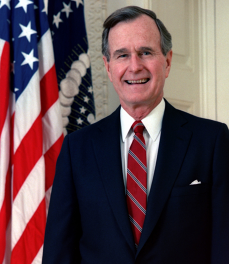
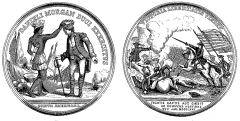
President George H. W. Bush posthumously awards Jesse Owens the Congressional Gold Medal.
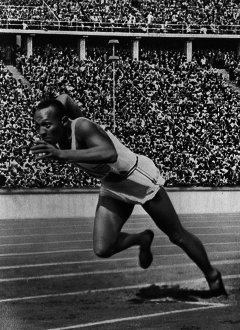
Jesse Owens won four gold medals at the 1936 Berlin Olympics and came home to a country that would not let him ride in the front of a bus. On March 28, 1990, President George H. W. Bush posthumously awarded Owens the Congressional Gold Medal, honoring the track and field athlete who had humiliated Adolf Hitler's theories of Aryan supremacy 54 years earlier. Owens had died in 1980 without ever receiving the nation's highest civilian honor during his lifetime. Owens arrived in Berlin as the son of an Alabama sharecropper and the grandson of enslaved people. Over six days in August 1936, he won gold in the 100 meters, 200 meters, long jump, and 4x100 meter relay, performances that demolished the Nazi regime's claims of racial superiority in front of 100,000 spectators in the Olympic Stadium. The German public cheered him wildly. Hitler, contrary to popular myth, did not publicly snub Owens; the Fuhrer had stopped congratulating any athletes after the first day. The real snub came at home. President Franklin Roosevelt never invited Owens to the White House or sent a telegram of congratulations. Owens returned to the United States to find that his athletic achievements opened no doors. He was reduced to racing horses for money, working as a gas station attendant, and filing for bankruptcy. "Hitler didn't snub me," Owens later said. "It was our president who snubbed me." The Congressional Gold Medal arrived a decade after his death, by which time Owens had been retroactively celebrated as an American hero. The delay between his achievement and his recognition tells a story about American race relations that the ceremony itself could not erase. Owens remains the most decorated athlete of the 1936 Olympics and a symbol of the gap between what America celebrated abroad and what it tolerated at home.
March 28, 1990
36 years ago
Key Figures & Places


What Else Happened on March 28
The Roman Senate formally invested Caligula with the full powers of the Principate following the death of Tiberius, consolidating absolute authority in the hand…

The Roman throne went to the highest bidder. After murdering Emperor Pertinax in March 193 AD, the Praetorian Guard, the elite unit theoretically responsible fo…

The Praetorian Guards literally auctioned the Roman Empire to the highest bidder. After murdering Emperor Pertinax in March 193 CE, they stood on their camp wal…
Emperor Valentinian I elevated his brother Valens to co-emperor at Constantinople, formally dividing the Roman Empire into western and eastern halves to address…

Charles the Bald paid 7,000 pounds of silver to make the Vikings go away, and in doing so, he advertised a business model that would terrorize Europe for the ne…

Seven thousand German pilgrims, starving and dying of thirst after three days of Bedouin raids near Caesarea, watched a Muslim army approach across the desert. …
Talk to History
Have a conversation with historical figures who witnessed this era. Ask questions, explore perspectives, and bring history to life.