

France and Britain Declare War on Russia
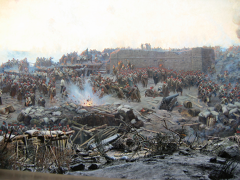
Britain and France declared war on Russia on March 28, 1854, entering a conflict that neither country fully understood and that no one would fight well. The Crimean War pitted the two Western European powers and the Ottoman Empire against Tsarist Russia over control of religious sites in the Holy Land, a pretext so thin that it masked the real issue: whether Russia would be allowed to expand at Ottoman expense and dominate the Black Sea. The immediate trigger was a dispute between Orthodox and Catholic monks over custody of holy sites in Jerusalem and Bethlehem, then part of the Ottoman Empire. Russia demanded that the Ottomans recognize the Tsar as protector of all Orthodox Christians within Ottoman territory, a demand that would have given Russia enormous influence over millions of Ottoman subjects. When the Ottomans refused, Russia occupied the Danubian Principalities (modern Romania). Britain and France, determined to prevent Russian expansion toward the Mediterranean, intervened. The war concentrated around the Russian naval base at Sevastopol on the Crimean Peninsula, where Allied forces landed in September 1854. The siege lasted nearly a year, conducted by armies ravaged by cholera, dysentery, and incompetent leadership. The Charge of the Light Brigade, a suicidal cavalry assault ordered by miscommunication, became the war's most famous episode and a symbol of aristocratic military incompetence. Florence Nightingale's work at the Scutari hospital, where she reduced mortality from 42 percent to 2 percent through sanitation reforms, had a more lasting impact. The Treaty of Paris in 1856 demilitarized the Black Sea and preserved Ottoman territorial integrity. More than 600,000 soldiers died, the majority from disease rather than combat. The war's lasting legacies were Nightingale's transformation of military nursing, the birth of modern war correspondence through journalists like William Howard Russell, and Russia's realization that it needed to modernize or decline.
March 28, 1854
172 years ago
Key Figures & Places

What Else Happened on March 28
The Roman Senate formally invested Caligula with the full powers of the Principate following the death of Tiberius, consolidating absolute authority in the hand…

The Roman throne went to the highest bidder. After murdering Emperor Pertinax in March 193 AD, the Praetorian Guard, the elite unit theoretically responsible fo…

The Praetorian Guards literally auctioned the Roman Empire to the highest bidder. After murdering Emperor Pertinax in March 193 CE, they stood on their camp wal…
Emperor Valentinian I elevated his brother Valens to co-emperor at Constantinople, formally dividing the Roman Empire into western and eastern halves to address…

Charles the Bald paid 7,000 pounds of silver to make the Vikings go away, and in doing so, he advertised a business model that would terrorize Europe for the ne…

Seven thousand German pilgrims, starving and dying of thirst after three days of Bedouin raids near Caesarea, watched a Muslim army approach across the desert. …
Talk to History
Have a conversation with historical figures who witnessed this era. Ask questions, explore perspectives, and bring history to life.