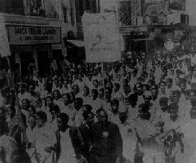
Bangladesh Declares Independence: East Pakistan Breaks Free
Sheikh Mujibur Rahman declared the independence of Bangladesh over a clandestine radio transmitter just hours before Pakistani soldiers arrested him. On March 26, 1971, East Pakistan broke from the western half of the country after months of political crisis triggered by West Pakistan's refusal to honor election results that would have made Mujib the prime minister of a united Pakistan. His arrest launched a nine-month liberation war that killed between 300,000 and three million people. The roots ran deep. East and West Pakistan, separated by 1,000 miles of Indian territory, had been yoked together at Partition in 1947 on the basis of shared Muslim identity. But the Bengali-speaking East had a larger population, generated more export revenue from jute, and received less government investment. West Pakistan dominated the military, civil service, and economy. When Mujib's Awami League won a landslide in the 1970 elections, General Yahya Khan and Zulfikar Ali Bhutto refused to transfer power. The Pakistani military launched Operation Searchlight on the night of March 25, targeting students, intellectuals, and Hindu minorities in Dhaka. Soldiers attacked Dhaka University, killing hundreds of students in their dormitories. The crackdown spread across East Pakistan, driving roughly 10 million Bengali refugees into India. The Pakistani army's systematic use of rape as a weapon of war, with estimates of 200,000 to 400,000 women assaulted, became one of the conflict's defining atrocities. India intervened militarily in December 1971, and Pakistani forces in Dhaka surrendered on December 16 after a 13-day war. Bangladesh became the world's newest nation, and Mujib returned from a Pakistani prison to lead it. He was assassinated by military officers four years later, but Bangladesh's independence, born from one of the 20th century's most devastating civil conflicts, endured.
March 26, 1971
55 years ago
Key Figures & Places

What Else Happened on March 26
Emperor Maurice elevated his son Theodosius to the rank of co-emperor, formally securing the Theodosian dynasty’s hold on the Byzantine throne. This calculated …
The first Eid al-Fitr wasn't planned—it emerged from exhaustion. After Muhammad and his followers completed the first mandatory Ramadan fast in 624 CE, they gat…
The body vanished during a donkey ride outside Cairo, but the Fatimid court pretended their caliph was still alive for six weeks. Al-Hakim bi-Amr Allah had terr…
Pope John XIX crowned Conrad II as Holy Roman Emperor in Rome, formalizing the Salian dynasty's grip on power. This coronation solidified the monarch's authorit…
Pope John XIX crowned Conrad II as Holy Roman Emperor in St. Peter's Basilica, solidifying the Salian dynasty's grip on power. This ceremony affirmed the allian…
He was supposed to be temporary. When Saladin's uncle Shirkuh died just two months after conquering Egypt, the 31-year-old Kurdish warrior took command of a lan…
Talk to History
Have a conversation with historical figures who witnessed this era. Ask questions, explore perspectives, and bring history to life.