
Wilson Announces Fourteen Points: WWI Peace Blueprint
Woodrow Wilson stood before Congress on January 8, 1918, and proposed rewriting the rules of international relations. His Fourteen Points speech laid out specific conditions for ending World War I that went far beyond the immediate conflict. Wilson called for freedom of navigation on the seas, removal of trade barriers, reduction of armaments, self-determination for subject peoples, and the creation of a League of Nations to guarantee collective security. No head of state had ever proposed anything so ambitious. The speech was addressed to Congress but aimed at the world. Wilson wanted to undermine German morale by offering a peace generous enough that the German people might pressure their government to accept it. He also needed to counter the Bolsheviks, who had just seized power in Russia and were publishing the secret treaties between the Allied powers, exposing the territorial bargains that France, Britain, Italy, and Russia had made while claiming to fight for democracy. Wilson''s idealism was partly strategic: by proposing open diplomacy and national self-determination, he drew a sharp contrast with both the old European system and the new Soviet alternative. The speech proposed dismantling empires. Austria-Hungary and the Ottoman Empire would be reorganized along ethnic lines. Poland would be reconstituted as an independent state. Colonial claims would be adjudicated impartially. Belgium would be evacuated and restored. Alsace-Lorraine would return to France. The principles were revolutionary, and the Allied leaders in London and Paris received them with deep skepticism. Georges Clemenceau reportedly quipped that even God had been content with only ten commandments. When the Paris Peace Conference convened in January 1919, the Fourteen Points were systematically gutted. Clemenceau demanded punitive reparations. Italy insisted on territorial gains promised in secret treaties. Japan wanted German colonial possessions in China. Wilson compromised on nearly everything except the League of Nations. His own Senate refused to ratify the Treaty of Versailles, largely over Article X, which critics argued could commit American troops abroad without congressional approval. The League survived, but without the United States, it lacked the power to enforce its decisions. The institution Wilson sacrificed everything to create collapsed within two decades.
January 8, 1918
108 years ago
Key Figures & Places
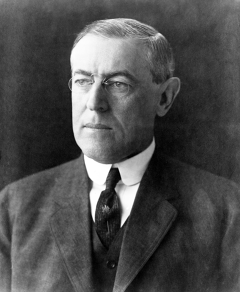
Woodrow Wilson
Wikipedia
Fourteen Points
Wikipedia
Woodrow Wilson
Wikipedia
Fourteen Points
Wikipedia
World War I
Wikipedia
League of Nations
Wikipedia
Ottoman Empire
Wikipedia
Gallipoli campaign
Wikipedia
United States Congress
Wikipedia
Droit des peuples à disposer d'eux-mêmes
Wikipedia
Bataille de Crouy
Wikipedia
What Else Happened on January 8
Emperor Jin Huidi died after consuming a poisoned cake, abruptly ending a reign defined by the devastating War of the Eight Princes. His son, Jin Huaidi, inheri…
A palace coup whispered through silk screens. Sima Chi didn't just inherit the throne—he seized it from his own blood. His brother Sima Zhong had been a weak ru…
Siyaj K'ak' seized the Maya city of Waka, installing a new ruler backed by the military might of Teotihuacán. This conquest forcibly integrated the Petén Basin …
Alfred the Great led his West Saxon forces to victory against a Viking army at the Battle of Ashdown. By securing this win, he prevented the total collapse of h…
King Ethelred of Wessex and his brother Alfred routed a Great Heathen Army at the Battle of Ashdown, securing a rare victory against the invading Danes. This tr…
A monk's robe and pure audacity: that was François Grimaldi's ticket to an entire principality. Sneaking past guards in religious disguise, he and his soldiers …
Talk to History
Have a conversation with historical figures who witnessed this era. Ask questions, explore perspectives, and bring history to life.