

Capital Moves to D.C.: U.S. Government Relocates
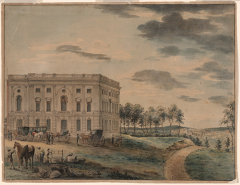
Federal clerks loaded crates of government documents onto wagons in Philadelphia during May 1800, beginning the transfer of the United States capital to a half-built city on the Potomac. The move to Washington, D.C., formalized by the Residence Act of 1790, fulfilled a compromise between Alexander Hamilton and Thomas Jefferson that traded a southern capital for federal assumption of state debts from the Revolutionary War. The city that awaited the government bore little resemblance to Pierre L'Enfant's grand vision. Pennsylvania Avenue was an unpaved track through swampland. The Capitol building had only one wing completed. The President's House, later called the White House, was habitable but unfinished, surrounded by construction debris and workmen's shacks. Abigail Adams, arriving in November, famously hung laundry in the East Room because it was the only space large enough to dry clothes. President John Adams arrived in June and became the first president to govern from the new capital. Congress convened there for the first time in November. Diplomats accustomed to Philadelphia's urbane society found themselves in what one ambassador described as a "city of magnificent distances," where grand avenues connected widely spaced clusters of buildings separated by forest, marsh, and open fields. The choice of location was deeply political. Southern states had insisted on a capital below the Mason-Dixon line, away from the commercial power of northern cities. The Potomac site, carved from Maryland and Virginia, placed the government in a neutral zone between North and South. That geographic compromise held symbolic weight for sixty years until the Civil War shattered the fiction of sectional balance. The city itself grew slowly, not reaching a population of 100,000 until the 1860s.
May 14, 1800
226 years ago
Key Figures & Places
session
Wikipedia

recesses
Wikipedia
Federal government of the United States
Wikipedia
Philadelphia
Wikipedia

Washington, D.C.
Wikipedia

6th United States Congress
Wikipedia

Recess (break)
Wikipedia

Federal government of the United States
Wikipedia

Philadelphia
Wikipedia

Washington, D.C.
Wikipedia

Pennsylvania
Wikipedia

Constitution of the United States
Wikipedia
What Else Happened on May 14
Robert II was dying, and his kingdom was about to tear itself apart. The old Capetian king had already watched one son rebel against him—his firstborn Hugh, co-…
The Byzantine emperor's ships were already in the lake. Alexios I had secretly sailed a fleet overland—dragged on wheeled platforms, piece by piece—to cut off N…

Simon de Montfort's rebel army smashed King Henry III's forces on the chalk downs above Lewes on May 14, 1264, capturing both the king and his son Prince Edward…
The mellah in Fez had walls for a reason. When the Marinid sultan fell in 1465, those walls didn't hold. Rioters poured through during three days of upheaval th…
He was thirteen years old and already losing his hair—a genetic curse that would earn Charles VIII the nickname "Charles the Affable" because what else could yo…
French forces crushed the Venetian army at the Battle of Agnadello, halting the Republic of Venice’s expansion onto the Italian mainland. This defeat forced the…
Talk to History
Have a conversation with historical figures who witnessed this era. Ask questions, explore perspectives, and bring history to life.