
Churchill Warns of Iron Curtain: Cold War Divides
Winston Churchill traveled to a small Presbyterian college in Fulton, Missouri, on March 5, 1946, at President Truman's personal invitation, and delivered the speech that gave the Cold War its most enduring metaphor. "From Stettin in the Baltic to Trieste in the Adriatic," Churchill declared, "an iron curtain has descended across the Continent." The phrase had been used before, but Churchill's Westminster College address made it the defining image of the post-war division of Europe. Churchill was out of power when he spoke. British voters had ejected him from Downing Street in July 1945, just weeks after victory in Europe, replacing him with Clement Attlee's Labour government. Churchill remained a Member of Parliament and Leader of the Opposition, but he was a private citizen on an extended American tour when Truman arranged the Westminster College appearance. Truman attended the speech and sat on the platform, a signal that while the Truman administration would not formally endorse the address, the president found its message congenial. The speech, officially titled "The Sinews of Peace," went far beyond the iron curtain metaphor. Churchill argued that the Soviet Union did not want war but desired "the fruits of war and the indefinite expansion of their power and doctrines." He called for a permanent Anglo-American military alliance, joint use of naval and air force bases, and continued sharing of atomic secrets — proposals that foreshadowed NATO, established three years later. The Soviet reaction was fierce. Stalin compared Churchill to Hitler in a Pravda interview, accusing him of warmongering and racial supremacy. American public opinion was divided: many liberals condemned the speech as provocative, while conservatives embraced it as a necessary warning. The Wall Street Journal criticized Churchill for trying to drag America into British imperial conflicts. Within two years, the Truman Doctrine, the Marshall Plan, and the Berlin Blockade had vindicated Churchill's analysis. The iron curtain would not lift for forty-three years. Churchill's Fulton address remains the earliest major public statement framing the post-war world as a bipolar confrontation between Western democracy and Soviet communism.
March 5, 1946
80 years ago
Key Figures & Places
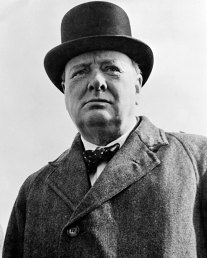
Winston Churchill
Wikipedia
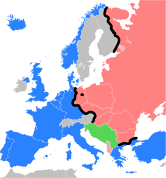
Iron Curtain
Wikipedia

Westminster College, Missouri
Wikipedia
Cold War
Wikipedia
Winston Churchill
Wikipedia
Iron Curtain
Wikipedia
Westminster College (Missouri)
Wikipedia
Fulton (Misuri)
Wikipedia
United States
Wikipedia
Discours de Fulton
Wikipedia
Harold S. Shapiro
Wikipedia
Mathematician
Wikipedia
University
Wikipedia
Missouri
Wikipedia

Soviet Union
Wikipedia
What Else Happened on March 5
Julian the Apostate brought 90,000 soldiers and a library when he marched from Antioch into Persia in March 363 AD. The last pagan Roman emperor was attempting …
Naser Khosrow was forty years old, hungover, and disgusted with himself when he decided to abandon his comfortable government career and walk across the Middle …
Grand Duke Traidenis crushed the Livonian Order at the Battle of Aizkraukle, killing the Master of the Order, Ernst von Rassau, and seventy knights. This decisi…
King Henry VII granted John Cabot and his sons royal authority to sail under the English flag in search of new lands. This expedition led to the first European …
The Vatican waited 73 years to ban Copernicus's book. Why? Because nobody thought it was serious. When *On the Revolutions of the Heavenly Spheres* appeared in …
The Catholic Church officially banned Nicolaus Copernicus’s *De revolutionibus orbium coelestium* in 1616, declaring his heliocentric model formally heretical. …
Talk to History
Have a conversation with historical figures who witnessed this era. Ask questions, explore perspectives, and bring history to life.