Britannia Bridge Opens: Engineering Marvel Unites Wales
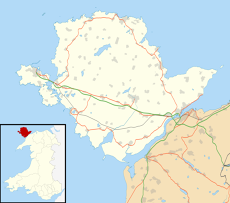
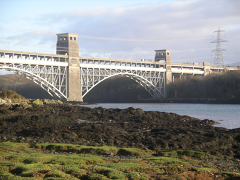
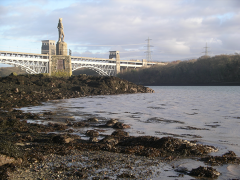
Robert Stephenson solved an engineering problem everyone said was impossible: how to carry a railway train across the Menai Strait without using arches that would block the Admiralty's shipping lanes or suspension chains that couldn't support the weight of a locomotive. His answer was the Britannia Bridge, opened on March 5, 1850, which used massive rectangular iron tubes large enough for trains to pass through, suspended 100 feet above the water. Nothing like it had ever been built. The need was commercial. The Chester and Holyhead Railway connected London to the port of Holyhead on Anglesey, from which mail packets sailed to Ireland. But Anglesey was separated from the Welsh mainland by the Menai Strait, a turbulent tidal channel roughly 400 meters wide. Thomas Telford's road suspension bridge, completed in 1826, already crossed the strait but could not carry railway traffic. The Admiralty demanded that any new bridge maintain a minimum 100-foot clearance for tall-masted ships. Stephenson, son of railway pioneer George Stephenson, consulted the mathematician Eaton Hodgkinson and the engineer William Fairbairn. They conducted extensive tests on iron plate structures and determined that a rectangular tube, built from riveted wrought iron plates, could support the weight of a loaded train over the required span. The design was unprecedented: two main spans of 460 feet each, with two smaller approach spans, all consisting of continuous rectangular tubes through which trains would travel as if through a tunnel. The tubes were assembled on shore and floated into position on pontoons during carefully timed tidal operations. Hydraulic presses lifted the 1,800-ton tubes into place on the bridge's limestone towers, a process watched by thousands of spectators. The central Britannia Tower, standing on a rock in the middle of the strait, rose 230 feet and became a landmark visible for miles. The bridge carried rail traffic for 120 years until a devastating fire in 1970, started by boys exploring the tubes with torches, melted the iron structure beyond repair. The rebuilt bridge, completed in 1972, used steel arches and added a road deck above the rail line. Stephenson's tubular bridge concept influenced a generation of engineers and proved that wrought iron could span distances previously thought impossible without stone arches.
March 5, 1850
176 years ago
Key Figures & Places

What Else Happened on March 5
Julian the Apostate brought 90,000 soldiers and a library when he marched from Antioch into Persia in March 363 AD. The last pagan Roman emperor was attempting …
Naser Khosrow was forty years old, hungover, and disgusted with himself when he decided to abandon his comfortable government career and walk across the Middle …
Grand Duke Traidenis crushed the Livonian Order at the Battle of Aizkraukle, killing the Master of the Order, Ernst von Rassau, and seventy knights. This decisi…
King Henry VII granted John Cabot and his sons royal authority to sail under the English flag in search of new lands. This expedition led to the first European …
The Vatican waited 73 years to ban Copernicus's book. Why? Because nobody thought it was serious. When *On the Revolutions of the Heavenly Spheres* appeared in …
The Catholic Church officially banned Nicolaus Copernicus’s *De revolutionibus orbium coelestium* in 1616, declaring his heliocentric model formally heretical. …
Talk to History
Have a conversation with historical figures who witnessed this era. Ask questions, explore perspectives, and bring history to life.