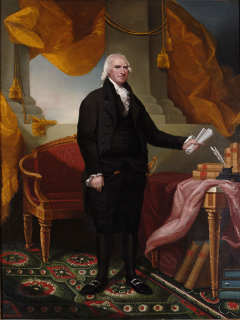
New York Elects Governor: State Self-Governance Established
New York held its first gubernatorial election in June 1777, choosing George Clinton as the state's first governor under its newly adopted constitution. Clinton won against Philip Schuyler, a wealthy landowner and Continental Army general, in an election that established civilian governance in New York while British forces occupied much of the state. The election took place during active warfare. British troops held New York City, Long Island, and Staten Island. The Hudson Valley was contested territory. Voters in occupied areas could not participate. The election was conducted across the remaining free territory of the state under conditions that would have made most democratic exercises impossible. Clinton was born in Little Britain, New York on July 26, 1739, the son of a farmer and local official of Irish descent. He had served in the French and Indian War and in the Continental Congress. He was not from New York's aristocratic elite, which made him attractive to voters who distrusted the landed families that had dominated colonial politics. His immediate priority as governor was military: organizing the state militia, coordinating with the Continental Army, and defending the Hudson Highlands, a strategic corridor that connected New England to the mid-Atlantic states. If the British gained control of the Hudson River, they could split the revolutionary states in two. Clinton personally commanded troops during the British assault on Forts Clinton and Montgomery in October 1777. He served as governor for an extraordinary twenty-one years across multiple terms, making him the longest-serving governor in New York history at that time. He was deeply skeptical of the proposed federal Constitution, opposing ratification in 1788 on the grounds that it concentrated too much power in the central government. He later served as Vice President under both Thomas Jefferson and James Madison. The 1777 election demonstrated that democratic governance could function even under military threat, establishing a precedent that civilian authority would not be suspended during wartime.
July 9, 1777
249 years ago
What Else Happened on July 9
Hadrian waited 367 days to enter his own capital. The new emperor spent that first year securing borders, executing four senators he claimed plotted against him…
Emperor Theodosius I concluded the First Council of Constantinople, formalizing the Nicene Creed as the official doctrine of the Roman Empire. By codifying the …
The Roman military commander Avitus ascended to the throne in Gaul, proclaimed Emperor by the Visigothic King Theodoric II. This elevation signaled the desperat…
The Heruli guardsmen attacked at night, elite troops betting everything on darkness and surprise. Odoacer had ruled Italy for fifteen years—longer than most emp…
A massive earthquake shattered Beirut and triggered a violent tsunami that leveled the coastal cities of Byzantine Phoenicia. This disaster claimed thousands of…
General Kim Yu-sin's Silla forces crushed the Baekje army at Hwangsanbeol, shattering their military power after fierce fighting that reportedly claimed thousan…
Talk to History
Have a conversation with historical figures who witnessed this era. Ask questions, explore perspectives, and bring history to life.