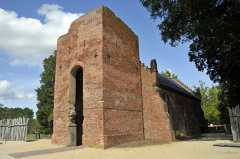
Jamestown Established: First Permanent English Settlement in America
One hundred four English colonists stepped ashore on a marshy peninsula in the James River on May 13, 1607, establishing Jamestown, the first permanent English settlement in the Americas. The Virginia Company of London had financed the expedition as a commercial venture, expecting the colonists to find gold, a passage to Asia, or profitable trade goods. They found mosquitoes, brackish water, and a powerful confederacy of Powhatan peoples who had no interest in sharing their territory. The site chosen for the settlement was strategically defensible, surrounded by deep water that allowed ships to dock close to shore, but environmentally disastrous. The marshy ground bred disease. The river water was contaminated with salt during high tides and with sewage during low ones. The gentlemen and adventurers who comprised much of the expedition had little experience with manual labor, farming, or survival in wilderness conditions. The first two years were catastrophic. The "starving time" of winter 1609-1610 reduced the colony's population from 500 to 60. Colonists ate rats, shoe leather, and according to forensic evidence discovered in 2013, at least one deceased colonist. Only the arrival of supply ships and the iron discipline imposed by leaders like Captain John Smith and later Sir Thomas Dale kept the settlement from being abandoned entirely. Jamestown's survival ultimately depended on tobacco. John Rolfe's cultivation of a Caribbean tobacco strain in 1612 gave the colony its first profitable export, creating an economic model that would define Virginia for two centuries. That model also created an insatiable demand for labor, leading first to indentured servitude and then, after 1619, to the importation of enslaved Africans. The commercial logic of Jamestown planted the seeds of both American prosperity and America's original sin.
May 13, 1607
419 years ago
Key Figures & Places

What Else Happened on May 13
The Turkish galleys outnumbered the Latin ships nearly two to one off Pallene's coast. Didn't matter. Humbert II of Vienne led twenty-eight vessels against fift…
She was thirty years old and dying when Jesus showed up sixteen times in her bedroom. Julian of Norwich spent May 8th, 1373 watching her own body fail—then watc…
She was thirty and dying when the visions started. Julian of Norwich, an anchorite locked voluntarily in a stone cell attached to St. Julian's Church, received …
Pope Alexander VI formally excommunicated the Dominican friar Girolamo Savonarola after the preacher’s relentless denunciations of papal corruption threatened t…
The man who'd just finished mapping coastlines for Spain switched jerseys. Vespucci sailed west again in 1501, but this time King Manuel I of Portugal cut his c…
They'd already married in secret in Paris—weeks earlier, pregnant and terrified. Mary Tudor had been France's queen for three months before her elderly husband …
Talk to History
Have a conversation with historical figures who witnessed this era. Ask questions, explore perspectives, and bring history to life.