US Launches Iraq War: Chaos Follows False Claims
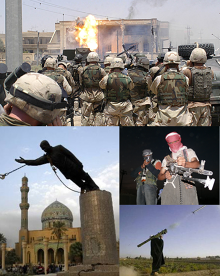
American cruise missiles struck Baghdad at 5:34 AM local time on March 20, 2003 (March 19 in U.S. time zones), launching a war that would cost trillions of dollars, kill hundreds of thousands of people, and destabilize the Middle East for decades. President George W. Bush announced the invasion in a televised address, declaring that "American and coalition forces are in the early stages of military operations to disarm Iraq, to free its people and to defend the world from grave danger." The case for war rested on two claims: that Iraqi dictator Saddam Hussein possessed weapons of mass destruction and that he maintained operational links to al-Qaeda. Both claims proved false. Secretary of State Colin Powell's February 2003 presentation to the United Nations Security Council, in which he displayed satellite imagery and cited intelligence sources to argue that Iraq was hiding chemical and biological weapons programs, was later acknowledged by Powell himself as a "blot" on his record. The military campaign was swift. Coalition forces crossed the Kuwaiti border on March 20 and reached Baghdad within three weeks. Saddam's regime collapsed as Iraqi army units dissolved rather than fight. The iconic toppling of Saddam's statue in Firdos Square on April 9 was broadcast worldwide, and Bush declared major combat operations over on May 1, 2003, aboard the aircraft carrier USS Abraham Lincoln beneath a banner reading "Mission Accomplished." The occupation that followed proved catastrophic. The decision to disband the Iraqi army, made by Coalition Provisional Authority head L. Paul Bremer, put 400,000 armed men out of work and created a pool of recruits for the insurgency that erupted within months. Sectarian violence between Sunni and Shia communities, suppressed under Saddam's dictatorship, exploded into civil war by 2006. The chaos provided the conditions for al-Qaeda in Iraq to establish itself and eventually evolve into the Islamic State. The weapons of mass destruction were never found because they did not exist.
March 19, 2003
23 years ago
Key Figures & Places
What Else Happened on March 19
Byzantine Emperor Michael VIII Palaiologos and the Venetian Republic secured a two-year truce, stabilizing trade routes across the Mediterranean. By renewing Ve…
The Mongol navy crushed the last Song dynasty resistance at the Battle of Yamen, driving the young emperor and his officials to drown themselves in the sea. Thi…
Yuan admiral Zhang Hongfan lured the desperate Song navy into a fatal trap at Yamen Bay in 1279, ending four centuries of Song Dynasty rule and completing the M…
Edward I didn't conquer Wales with a final battle — he did it with paperwork. The Statute of Rhuddlan transformed centuries of Welsh independence into sixteen c…
The journey nearly killed him before he reached Rome. Frederick III spent sixteen months traveling from Vienna to his coronation, dragging his entire court acro…
Catherine de Medici's thirteen-year-old son Charles IX sat on the throne of France as his mother negotiated the Edict of Amboise, signed on March 19, 1563, endi…
Talk to History
Have a conversation with historical figures who witnessed this era. Ask questions, explore perspectives, and bring history to life.