
Pilgrims Sign Compact: America's First Democracy Born
Forty-one men crowded into the cabin of a creaking ship and signed a document that would echo through four centuries of democratic governance. Anchored in the harbor of what is now Provincetown, Massachusetts, the passengers of the Mayflower created a framework for self-rule before anyone set foot on shore. The Mayflower Compact was not born of idealism alone but of urgent practical necessity. The Pilgrims had a problem. Their patent from the Virginia Company authorized settlement in the Hudson River area, but storms had blown them far north to Cape Cod, outside any English jurisdiction. Several non-Pilgrim passengers, whom William Bradford later called "strangers," announced they would be "free from the rule of any man" once ashore. Without some agreement, the colony risked dissolving before it began. The compact they drafted was remarkably brief, barely 200 words. The signers agreed to "covenant and combine ourselves together into a civil body politic" and to enact "just and equal laws" for the general good of the colony. John Carver was elected the first governor. The document drew on traditions the Separatists knew well, particularly the church covenants that bound Puritan congregations together through voluntary consent rather than imposed authority. What made the compact revolutionary was its underlying premise. Authority derived not from a monarch or a charter company but from the consent of the governed. Every adult male, regardless of religious affiliation, was included. This was not democracy as later generations would understand it, but the principle that a community could constitute its own government through mutual agreement was radical for 1620. The compact governed Plymouth Colony for 71 years until it was absorbed into Massachusetts Bay in 1691. The self-governing tradition it established became a foundational thread in the political culture that produced the Declaration of Independence 156 years later.
November 11, 1620
406 years ago
Key Figures & Places
Cape Cod
Wikipedia
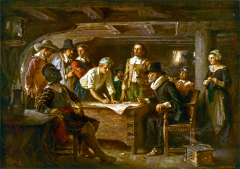
Mayflower Compact
Wikipedia
Provincetown Harbor
Wikipedia
Mayflower Compact
Wikipedia
Provincetown Harbor
Wikipedia
Cape Cod
Wikipedia
Plymouth Colony
Wikipedia
United States
Wikipedia
Pearl Harbor
Wikipedia
Hawaii
Wikipedia
Pacific Ocean
Wikipedia
دونالد شتاينر
Wikipedia
Biochemist
Wikipedia
ليان زيمبلر
Wikipedia
What Else Happened on November 11
Four Roman emperors walked into a conference and none of them left happy. At Carnuntum — a military camp on the Danube — Diocletian himself came out of retireme…
Constantine VIII's death after sixty-six years on the throne triggered a chaotic succession crisis that plunged the Byzantine Empire into instability. His daugh…
She changed her name to get married. Born Edith, she took the name Matilda the day Henry I slipped a crown on her head, likely to sound less foreign to Norman e…
She wasn't just a Scottish princess — she was a political masterstroke in a veil. Henry I needed legitimacy after seizing the English throne while his brother R…
Pope Innocent III didn't just host a meeting — he orchestrated the largest church council in medieval history, pulling 1,200 bishops and abbots to Rome. And out…
Louis XII of France and Ferdinand II of Aragon signed the Treaty of Granada on November 11, 1500, agreeing to divide the Kingdom of Naples between themselves an…
Talk to History
Have a conversation with historical figures who witnessed this era. Ask questions, explore perspectives, and bring history to life.