Saratoga Surrenders: France Joins American Revolution
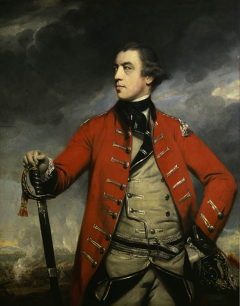
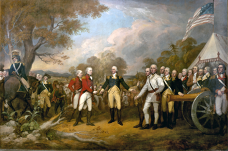
British General John Burgoyne surrendered 5,895 soldiers to American forces at Saratoga, New York, on October 17, 1777, handing the Continental Army its most important victory of the Revolutionary War and triggering the diplomatic earthquake that made American independence possible. France, which had been secretly supplying the rebels but hesitating to commit openly, recognized the United States and entered the war as a full military ally within months. Burgoyne had marched south from Canada in June 1777 with a force of roughly 8,000 British regulars, German mercenaries, and Native American allies, aiming to split New England from the rest of the colonies by seizing control of the Hudson River valley. The plan required coordinated movements from three British columns converging on Albany, but the coordination never materialized. General William Howe took his army to Philadelphia instead, and a smaller force from the west was repulsed at Fort Stanwix. Burgoyne's increasingly isolated army fought two brutal engagements near Saratoga — the battles of Freeman's Farm on September 19 and Bemis Heights on October 7. American forces under General Horatio Gates, with critical tactical leadership from Benedict Arnold (who was wounded and nearly killed in the fighting), inflicted heavy casualties and cut off Burgoyne's supply lines and retreat route. Surrounded, outnumbered nearly three to one, and with no prospect of relief, Burgoyne negotiated a "Convention" under which his troops would lay down their arms and return to Britain on the condition that they would not serve again in the American war. The victory electrified the American cause and alarmed European courts. Benjamin Franklin, serving as American ambassador in Paris, leveraged the news to negotiate the Treaty of Alliance with France in February 1778. French entry transformed the war from a colonial rebellion into a global conflict, stretching British military resources across the Caribbean, India, and Europe. Without Saratoga and the French alliance it produced, the American Revolution almost certainly would have failed.
October 17, 1777
249 years ago
Key Figures & Places
What Else Happened on October 17
Cyrus the Great entered Babylon without a battle. The city's priests had turned against their own king. Cyrus issued a decree allowing exiled peoples to return …
Ricimer defeated the Roman emperor Avitus near Piacenza with help from Majorian. Avitus had ruled for just 14 months. He fled to a church, was made a bishop aga…
Wu Zetian declared herself emperor of China on October 16th, 690, the only woman to ever claim that title outright. She'd been a concubine, then empress consort…
A tornado tore through London on October 17th, 1091, destroying 600 houses and killing two people. Medieval chroniclers said it lifted the roof off a church and…
King David II of Scotland invaded northern England while Edward III was fighting in France. Bad timing. English forces intercepted him at Neville's Cross near D…
King David II of Scotland invaded England in 1346 while Edward III was busy in France. Bad timing. English forces caught David at Neville's Cross near Durham on…
Talk to History
Have a conversation with historical figures who witnessed this era. Ask questions, explore perspectives, and bring history to life.