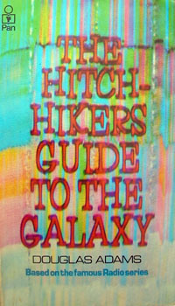
Hitchhiker's Guide Published: Universe Gets Satire
"In the beginning the Universe was created. This has made a lot of people very angry and been widely regarded as a bad move." With lines like that, Douglas Adams created one of the most quotable and beloved works of science fiction ever written when The Hitchhiker's Guide to the Galaxy was published on October 12, 1979. The novel began as a BBC Radio 4 series in 1978 and would eventually spawn five novels, a television series, a feature film, and a devoted global following. Adams conceived the idea while lying drunk in a field in Innsbruck, Austria, in 1971, clutching a copy of the Hitch-hiker's Guide to Europe and staring at the stars. The story follows Arthur Dent, a bewildered Englishman who escapes Earth's destruction (to make way for a hyperspace bypass) by hitchhiking on an alien spacecraft with his friend Ford Prefect, a researcher for the eponymous Guide. The book's genius lay in applying British absurdist humor to the grandest possible canvas — the meaning of life, the universe, and everything. The novel's answer to the ultimate question of existence — the number 42, delivered by a supercomputer after millions of years of calculation — became one of the most recognized jokes in literary history. Adams's writing blended philosophical wit with sharp social satire, skewering bureaucracy, technology worship, and human self-importance with equal delight. Adams was a notoriously slow writer who famously said, "I love deadlines. I love the whooshing noise they make as they go by." He produced four sequels of varying quality before his sudden death from a heart attack in 2001 at age 49. The Hitchhiker's Guide influenced an entire generation of comedic science fiction writers and technologists — the original concept of a portable electronic encyclopedia containing all knowledge arguably anticipated Wikipedia and smartphones by decades. The book has sold more than 15 million copies and been translated into over 30 languages.
October 12, 1979
47 years ago
Key Figures & Places
What Else Happened on October 12
Cyrus the Great's forces marched into Babylon on October 12, 539 BC, toppling a millennia-old empire without a battle. This conquest immediately freed Jewish ca…
Cyrus the Great marched his Persian forces into Babylon, ending the Neo-Babylonian Empire without a major battle. By allowing the city’s captive populations, in…
Edwin of Northumbria died at Hatfield Chase with most of his army. He'd united northern England and converted to Christianity. Penda of Mercia and Cadwallon of …
King Ladislaus I established the fortress of Varadinum, formally documenting the site now known as Oradea in a papal bull. This administrative recognition trans…
King John lost the English Crown Jewels in The Wash in 1216 when his baggage train tried to cross the estuary at low tide and misjudged the timing. The tide cam…
Nichiren Shōshū split from other Buddhist schools on October 12, 1279, when Nikko left Mount Minobu after a dispute over doctrine. He founded Taiseki-ji temple …
Talk to History
Have a conversation with historical figures who witnessed this era. Ask questions, explore perspectives, and bring history to life.