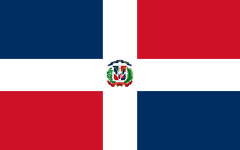
Dominican Republic Declares Independence From Haiti
Juan Pablo Duarte's secret society numbered barely a hundred members when it launched an independence movement against an occupying power that controlled every institution on the island. The Trinitarios, named for their founding cell of three-man groups designed to prevent infiltration, declared Dominican independence from Haiti on the night of February 27, 1844, firing a symbolic cannon shot from the Puerta del Conde in Santo Domingo. The revolution succeeded with almost no bloodshed, but the nation it created would spend the next two decades fighting to survive. Haiti had occupied the eastern two-thirds of Hispaniola since 1822, when Haitian forces marched into Santo Domingo largely unopposed. The occupation abolished slavery, which won support from the formerly enslaved population, but it also imposed heavy taxes, confiscated Church property, restricted the use of Spanish in official business, and redistributed land. Dominican elites, particularly the educated creole class, chafed under Haitian rule and began organizing resistance. Duarte, a young intellectual educated in Europe, founded La Trinitaria in 1838 with Francisco del Rosario Sanchez and Ramon Matias Mella. The group spent six years building a clandestine network while Duarte traveled abroad seeking foreign support. When the moment came, Duarte was in exile, and it was Sanchez and Mella who led the actual revolt. The Haitian garrison in Santo Domingo was caught off guard, and Dominican militias quickly secured the capital. Pedro Santana, a wealthy cattle rancher from the east, provided the military muscle that the intellectuals of La Trinitaria lacked. Independence did not bring stability. Haiti invaded four times between 1844 and 1856, and internal politics devolved into a power struggle between Santana, who favored annexation to Spain, and Buenaventura Baez, who courted the United States. Santana eventually succeeded in returning the country to Spanish rule in 1861, an arrangement that lasted just four years before another revolt restored sovereignty. The Dominican Republic's founding remains one of the few successful independence movements directed against another formerly colonized nation, a distinction that gives its national story a complexity most liberation narratives lack.
February 27, 1844
182 years ago
Key Figures & Places
What Else Happened on February 27
Emperor Theodosius I made Christianity the only legal religion of the Roman Empire on February 27, 380. Not just legal — mandatory. The Edict of Thessalonica de…
Theodosius II built the University of Constantinople in 425 because his wife told him to. Aelia Eudocia, a poet and intellectual who had been born Athenais and …
Abaoji unified the disparate Khitan tribes and assumed the title of khagan, consolidating power over the vast steppes of Inner Mongolia. This centralization tra…
A nomadic warlord who couldn't read Chinese became emperor of a dynasty that would last two centuries. Abaoji unified the Khitan tribes through a mix of marriag…
England sent troops into Scotland in 1560 because Scottish nobles asked them to. The Lords of the Congregation wanted French soldiers out. They'd been there sin…
England and Scotland's Protestant lords signed the Treaty of Berwick on February 27, 1560, creating a military alliance that would expel French troops from Scot…
Talk to History
Have a conversation with historical figures who witnessed this era. Ask questions, explore perspectives, and bring history to life.