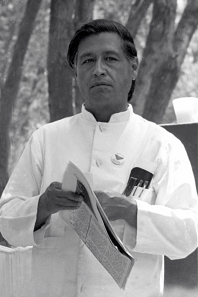
Chavez Organizes Farm Workers: A Movement Born
César Chávez had ten dollars in his pocket and a conviction that the most exploited workers in America deserved a union. On September 30, 1962, in an abandoned theater in Fresno, California, he founded the National Farm Workers Association, the organization that would become the United Farm Workers and launch the most successful labor movement of the late 20th century. Chávez grew up in the fields. Born to a Mexican American family in Yuma, Arizona, he became a migrant farm worker at age ten after his family lost their homestead during the Depression. He attended dozens of schools, never graduated from eighth grade, and spent his youth picking cotton, grapes, and vegetables across California's Central Valley. He understood from personal experience that farm workers lived in conditions most Americans associated with a previous century: no minimum wage, no overtime, no toilets in the fields, no clean drinking water, and constant exposure to pesticides. Chávez spent a decade as a community organizer with the Community Service Organization before concluding that farm workers needed their own union, not just civic programs. He moved to Delano, California, and spent months driving from labor camp to labor camp, talking to workers one family at a time. The Fresno convention drew over 150 delegates who adopted a union flag featuring a black Aztec eagle on a red and white background. The breakthrough came in 1965 when Filipino grape workers in Delano, led by Larry Itliong and the Agricultural Workers Organizing Committee, launched a strike against grape growers. Chávez's NFWA joined the strike, and the two organizations eventually merged into the United Farm Workers. Chávez expanded the conflict into a national consumer boycott of California table grapes that lasted five years and enlisted the support of Robert Kennedy, Walter Reuther, and millions of ordinary Americans who stopped buying grapes in solidarity. The first union contracts were signed in 1970, granting farm workers wage increases, health benefits, and protections against pesticide exposure. California passed the Agricultural Labor Relations Act in 1975, the first law in the country granting farm workers collective bargaining rights. Chávez's methods, drawn from Gandhi and Martin Luther King Jr., included fasting, marches, and strict nonviolence. His 1968 fast in Delano lasted 25 days and brought national attention to the cause. He died in 1993 and was posthumously awarded the Presidential Medal of Freedom.
September 30, 1962
64 years ago
Key Figures & Places

What Else Happened on September 30
Fred Flintstone's feet were the engine and the brakes. The Flintstones premiered on ABC on September 30, 1960, animated by Hanna-Barbera as the first primetime …
Theoderic the Great had already beaten Odoacer once, at the Isonzo River. Odoacer retreated to Verona in 489, regrouped, and met the Ostrogoths again under the …
The Umayyad general Asad ibn Abdallah al-Qasri pushed his army deep into Central Asia in 737, further than any Arab force had gone. The Turgesh didn't meet him …
A magnitude 7.7 earthquake struck the Caucasus mountains under Seljuk rule on September 30, 1139, leveling cities and killing an estimated 230,000 to 300,000 pe…
At Morlaix in 1342, a small English force of around 1,500 men faced a French army three times its size — and won, by digging hidden trenches the night before ba…
He'd been exiled, disinherited, and given just enough rope to hang himself. Henry Bolingbroke took that rope and used it to strangle a king instead. Richard II …
Talk to History
Have a conversation with historical figures who witnessed this era. Ask questions, explore perspectives, and bring history to life.