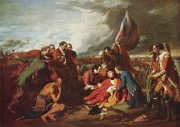
Quebec Falls: Britain Dominates North America
The French garrison of Quebec City surrendered to the British on September 18, 1759, five days after the Battle of the Plains of Abraham had shattered France’s ability to hold its most important fortress in North America. The capitulation handed Britain control of the St. Lawrence River and effectively ended 150 years of French colonial dominion over Canada. Both commanding generals who fought for the city were already dead. The fall of Quebec was the culmination of a months-long campaign during the Seven Years’ War. Major General James Wolfe had sailed up the St. Lawrence in June with 8,500 troops and a naval squadron, but the cliffs and fortifications protecting Quebec seemed impregnable. Wolfe spent the summer bombarding the Lower Town into rubble, raiding surrounding parishes, and launching failed assaults at Montmorency Falls. By early September, with the campaigning season ending, he conceived the desperate plan to scale the cliffs at Anse-au-Foulon west of the city. The gambit succeeded spectacularly. British troops climbed the narrow path in darkness on September 13 and formed a battle line on the plains above. The Marquis de Montcalm, rather than waiting behind Quebec’s walls for reinforcements that were nearby, attacked with his regular troops and militia. The resulting battle lasted roughly thirty minutes. A devastating British volley at close range broke the French charge, and Montcalm’s army retreated in disorder. Both Wolfe and Montcalm died of their wounds. The French garrison commander, Jean-Baptiste-Nicolas-Roch de Ramezay, held out for five days as supplies dwindled and morale collapsed. A relief force under Chevalier de Levis was marching toward Quebec, but Ramezay, unaware of its approach and facing pressure from the city’s civilian leaders, negotiated surrender terms on September 18. The city’s residents were guaranteed their property, religious freedom, and civil rights under British rule, terms that shaped the bilingual and bicultural character of Canada. The Treaty of Paris in 1763 formally transferred all of New France to Britain, an outcome that made the American Revolution possible by removing the French threat that had kept the thirteen colonies dependent on British military protection.
September 18, 1759
267 years ago
Key Figures & Places

What Else Happened on September 18
The Roman Senate formally confirmed Tiberius as emperor, solidifying the transition of power after Augustus died of natural causes. This peaceful succession pro…
Court officials and his own wife, Domitia, orchestrated the assassination of Emperor Domitian, ending his fifteen-year reign of terror. The Senate immediately p…
The Roman Senate proclaimed Nerva emperor immediately following Domitian’s assassination, ending the Flavian dynasty’s erratic rule. By choosing a respected eld…
Licinius had ruled the eastern half of the Roman Empire for years, but Constantine had been closing the distance. The Battle of Chrysopolis on September 18, 324…
The Seljuq commander Kutalmış led a cavalry force deep into Byzantine Armenia and met a combined Byzantine-Georgian army near Kapetron — and won. The Byzantines…
Harald Hardrada and Tostig Godwinson anchored their fleet at the mouth of the Humber River, launching a desperate bid to seize the English throne. This invasion…
Talk to History
Have a conversation with historical figures who witnessed this era. Ask questions, explore perspectives, and bring history to life.