Michelangelo Completes David: Renaissance Masterpiece
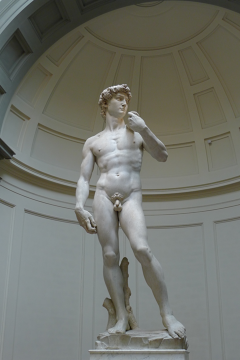
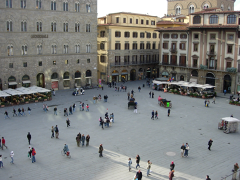
Michelangelo's David was unveiled in the Piazza della Signoria in Florence on September 8, 1504, and the 17-foot marble figure immediately became the most celebrated work of art in a city already overflowing with masterpieces. The statue had taken Michelangelo three years to carve from a single block of Carrara marble that two previous sculptors had attempted and abandoned, leaving a narrow, shallow slab that most artists considered ruined. Michelangelo was 26 years old when he accepted the commission and 29 when the finished David was dragged on greased logs from his workshop to the piazza, a journey that took four days and required 40 men. The block of marble, known as "The Giant," had sat exposed to the elements in the courtyard of the Florence Cathedral workshop for 25 years after Agostino di Duccio and then Antonio Rossellino failed to produce a statue from it. The stone was unusually tall and thin, and the previous attempts had removed enough material to severely constrain what any subsequent sculptor could achieve. Michelangelo studied the damaged block and produced a figure that worked within its limitations so brilliantly that the constraints became invisible. The slight turn of David's head, the tension in his right hand, and the exaggerated proportions of the hands and head were all calculated to be viewed from below, where the statue was intended to stand. The committee that reviewed the finished work included Leonardo da Vinci, Sandro Botticelli, and other leading Florentine artists, who debated its placement for weeks. The original plan had the David mounted on a buttress of the cathedral, high above the street. Instead, the committee chose the entrance to the Palazzo della Signoria, the seat of Florentine government, where the statue took on explicit political meaning: David, the young shepherd who defeated Goliath, symbolized the Florentine republic's defiance against larger, more powerful enemies. David remained in the piazza for over 350 years before being moved indoors to the Galleria dell'Accademia in 1873 to protect it from weather damage. A replica now stands in its original position. The statue draws over 1.5 million visitors annually, and its image has become so ubiquitous that the sheer physical impact of standing before the original, confronting 14,000 pounds of marble brought to life by a chisel, still catches visitors unprepared.
September 8, 1504
522 years ago
Key Figures & Places
What Else Happened on September 8
Roman legions under Titus breached the walls of Jerusalem, systematically dismantling the Second Temple and ending the Great Jewish Revolt. This destruction for…
Roman forces under Titus sacked Jerusalem on September 8, 70 AD, plundering the Temple treasury and burning the city after a months-long siege that starved the …
Li Yuan didn't want to rebel. His daughter Li Pingyang did. She raised her own army — reportedly 70,000 soldiers — while her father stalled, and her brother Li …
Antipope Theodoric's papacy lasted almost no time at all. Elected by a faction opposing the legitimate pope Paschal II in 1100, he held the title for only a few…
Philip of Swabia was crowned inside the Cathedral of Mainz by a single bishop in September 1198 — not in the traditional location, not with the traditional crow…
Pope Innocent IV canonized Stanisław of Szczepanów, the Bishop of Kraków who died at the hands of King Bolesław II. This formal recognition transformed a martyr…
Talk to History
Have a conversation with historical figures who witnessed this era. Ask questions, explore perspectives, and bring history to life.