

People Power: Marcos Flees, Aquino Takes Philippines
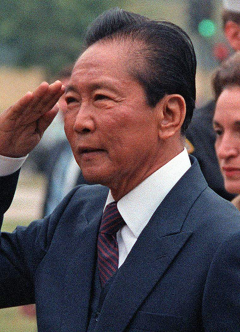
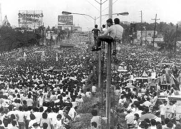
Ferdinand Marcos fled the Philippines with twenty-two crates of cash, gold bars, and his wife Imelda's legendary collection of designer shoes, lifted off the palace grounds by American military helicopters bound for exile in Hawaii. His departure on February 25, 1986, ended a twenty-year dictatorship and completed one of the most remarkable nonviolent revolutions in modern history — four days that proved a dictator could be toppled by ordinary people standing in front of tanks. The crisis had been building since the assassination of opposition leader Benigno Aquino Jr. on the airport tarmac in 1983. Marcos called a snap presidential election in February 1986, confident he could manufacture a victory against Aquino's widow, Corazon. When official counts showed Marcos winning despite overwhelming evidence of fraud — thirty computer technicians walked out of the tabulation center in protest — two senior military officers, Defense Minister Juan Ponce Enrile and Lieutenant General Fidel Ramos, defected and barricaded themselves in military camps along Epifanio de los Santos Avenue, known as EDSA. Cardinal Jaime Sin went on Radio Veritas and asked Filipinos to protect the rebel soldiers. Within hours, hundreds of thousands of people flooded EDSA, forming a human shield between the defectors and Marcos's loyalist forces. Nuns knelt before armored personnel carriers. Civilians offered food and flowers to soldiers. When Marcos ordered tanks to advance, the crews refused to fire into the crowd. The standoff lasted four days, broadcast live on international television. Corazon Aquino was inaugurated as president on the morning Marcos fled. She inherited a nation buried in $28 billion of foreign debt, with institutions hollowed out by crony capitalism. The People Power Revolution inspired nonviolent movements worldwide, from the fall of the Berlin Wall to the protests in Tiananmen Square. The Philippines itself would revisit its Marcos reckoning decades later when Ferdinand Jr. won the presidency in 2022, demonstrating that the memory of dictatorship fades faster than its consequences.
February 25, 1986
40 years ago
Key Figures & Places

Philippines
Wikipedia
President
Wikipedia
Ferdinand Marcos
Wikipedia

Corazon Aquino
Wikipedia
People Power Revolution
Wikipedia

People Power Revolution
Wikipedia

Ferdinand Marcos
Wikipedia

Corazon Aquino
Wikipedia

Philippines
Wikipedia
Resistencia civil
Wikipedia

Historia de Filipinas
Wikipedia

President of the Philippines
Wikipedia

Fidel V. Ramos
Wikipedia

List of presidents of the Philippines
Wikipedia
What Else Happened on February 25
Hadrian formally adopted Antoninus Pius, securing a peaceful transition of power that ensured the stability of the Roman Empire for the next two decades. By man…
Theodoric the Great promised Odoacer they'd rule Italy together. They signed the treaty on March 5, 493. Ten days later, at a banquet meant to celebrate their p…
Kavadh II seized the Sasanian throne after orchestrating a coup against his father, Khosrow II, ending a reign defined by exhausting, decades-long wars with the…
Khosrau II ruled Persia for 38 years and lost everything in six months. He'd conquered Egypt, Syria, and pushed Roman forces back to Constantinople's walls. The…
Four thousand defenders of Pilėnai burned their fortress to the ground, choosing mass suicide over capture by the encroaching Teutonic Knights. This desperate a…
Pope Pius V issued the papal bull Regnans in Excelsis, formally excommunicating Queen Elizabeth I and declaring her a heretic. This decree released English Cath…
Talk to History
Have a conversation with historical figures who witnessed this era. Ask questions, explore perspectives, and bring history to life.