Agent Orange Sprayed: Vietnam's Toxic Legacy Begins
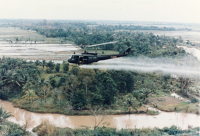
American military aircraft sprayed a chemical herbicide over the Vietnamese jungle on August 10, 1961, marking the first use of Agent Orange in the Vietnam War. The operation was part of a defoliation campaign designed to strip the dense tropical canopy that concealed Viet Cong supply lines and staging areas along the Ho Chi Minh Trail. What began as a tactical measure to deny the enemy cover became one of the most devastating environmental and humanitarian disasters of the twentieth century. Agent Orange was a mixture of two herbicides, 2,4-D and 2,4,5-T, manufactured in concentrated form and sprayed from C-123 transport aircraft in Operation Ranch Hand, which adopted the motto "Only We Can Prevent Forests." The chemical's name came from the orange stripe painted on its storage drums. Between 1961 and 1971, approximately 20 million gallons of Agent Orange and other herbicides were sprayed over roughly 4.5 million acres of South Vietnam — an area larger than Connecticut and Rhode Island combined. The manufacturing process produced a toxic contaminant: dioxin (TCDD), one of the most poisonous substances known to science. Military planners either did not know or did not adequately consider the health effects of dioxin exposure. Millions of Vietnamese civilians and hundreds of thousands of American service members were exposed. The consequences emerged over years and decades: elevated rates of cancer, birth defects, neurological disorders, and other chronic illnesses among both Vietnamese populations and American veterans. The U.S. military halted Agent Orange use in 1971 after studies confirmed its toxicity, but the damage was already embedded in Vietnam's soil, water, and food chain. Dioxin persists in the environment for decades. The Vietnamese government estimates that three million of its citizens suffer health effects from herbicide exposure, including second and third-generation birth defects. American veterans fought for decades to obtain disability recognition and healthcare, achieving significant legal victories only in the 1990s and 2000s. A weapon designed to kill trees ended up poisoning generations of people on both sides of the war.
August 10, 1961
65 years ago
Key Figures & Places
What Else Happened on August 10
Nineveh fell in 612 BCE. The Assyrian Empire had been the most powerful military machine in the ancient Near East for centuries — they used mass deportations, s…
The Prophet Muhammad received his first revelation from the angel Jibril within the cave of Hira, initiating the descent of the Qur'an. This night, known as Lay…
Pope Eugene I was elected in 654 while his predecessor Martinus I was still alive in exile — arrested by the Byzantine Emperor for opposing imperial theology. E…
The Battle of Lechfeld in 955 ended fifty years of Magyar raids into Western Europe. Otto I of Germany met a Magyar force on the Lech River with a cavalry charg…
The Battle of Maldon in 991 is famous because it failed so completely and someone wrote a poem about it. The English earl Bryhtnoth faced a Viking raiding party…
Byzantine Emperor Romanos III Argyros led his army against the Mirdasid rulers of Aleppo at the Battle of Azaz on August 10, 1030, only to see his forces crumbl…
Talk to History
Have a conversation with historical figures who witnessed this era. Ask questions, explore perspectives, and bring history to life.