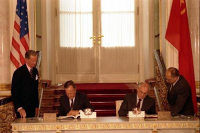
START Treaty Signed: US and USSR Slash Nuclear Arms
President George H.W. Bush and Soviet President Mikhail Gorbachev signed the Strategic Arms Reduction Treaty in Moscow on July 31, 1991, committing the world's two nuclear superpowers to destroy thousands of warheads and delivery systems for the first time in history. Previous arms agreements had limited growth; START actually required both sides to cut. The treaty had taken nine years to negotiate, beginning with President Ronald Reagan's 1982 proposal to rename the Strategic Arms Limitation Talks as Strategic Arms Reduction Talks, signaling a shift from merely capping arsenals to shrinking them. Reagan's vision was straightforward: both sides had far more nuclear weapons than any rational military strategy could justify, and mutual reduction would make the world safer without disadvantaging either power. The negotiations proceeded through summits at Geneva, Reykjavik, and Washington, surviving the Soviet invasion of Afghanistan, the deployment of Pershing II missiles in Europe, and Reagan's insistence on pursuing the Strategic Defense Initiative. START I established specific, verifiable limits. Each side could deploy no more than 6,000 nuclear warheads on a maximum of 1,600 delivery vehicles, including intercontinental ballistic missiles, submarine-launched ballistic missiles, and heavy bombers. The treaty included the most intrusive verification regime ever negotiated: on-site inspections, continuous monitoring of missile production facilities, and detailed data exchanges on every deployed weapon system. Implementation took a decade and was complicated by the collapse of the Soviet Union just five months after signing. Nuclear weapons were suddenly stationed in four independent nations: Russia, Ukraine, Belarus, and Kazakhstan. The Lisbon Protocol of 1992 brought the three non-Russian states into the treaty framework, and all three eventually transferred their warheads to Russia and joined the Nuclear Non-Proliferation Treaty as non-nuclear states. By the time START I was fully implemented in December 2001, approximately 80 percent of the strategic nuclear weapons that existed at the time of signing had been removed from deployment, the largest verified reduction of nuclear arms in history.
July 31, 1991
35 years ago
Key Figures & Places
What Else Happened on July 31
Mark Antony led a cavalry charge out of Alexandria on July 31, 30 BC, and routed Octavian's horsemen in what would be the last Roman victory he ever won. By nig…
Ash rained down on the surrounding plains as Mount Fuji erupted for the first time in recorded history. This event established the volcano’s status as an active…
Mount Fuji erupted for the first recorded time, spewing ash and debris that blanketed the surrounding plains. This geological event forced local communities to …
The largest naval raid in Byzantine history arrived with 54 Arab ships commanded by Leo of Tripoli, a Greek convert to Islam who knew exactly which harbor defen…
Pietro Martino Boccapecora took the name Sergius IV when he became pope — but everyone still called him "Pig's Snout" behind his back. His birth name meant exac…
A 300-pound Byzantine nobleman convinced himself he could overthrow Emperor Alexios III by simply showing up at the palace. John Komnenos the Fat—his actual his…
Talk to History
Have a conversation with historical figures who witnessed this era. Ask questions, explore perspectives, and bring history to life.