

Land Demonstrates Instant Camera: Polaroid Is Born
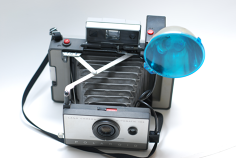
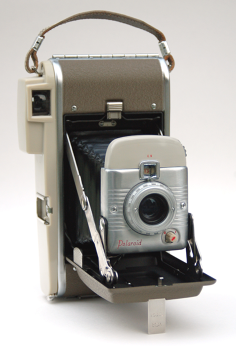
Edwin Land's three-year-old daughter asked a simple question that launched a billion-dollar industry: why couldn't she see the photograph right away? Land, already a successful inventor who had developed polarizing filters for sunglasses and military optics, took a walk through Santa Fe and worked out the basic chemistry of instant photography in a single afternoon. Three years later, he stood before the Optical Society of America in New York and demonstrated the impossible. The challenge Land solved was extraordinary. Conventional photography required a darkroom, chemical baths, and hours of processing. Land's system compressed the entire development process into a thin packet of chemicals sandwiched between layers of film. When a photograph was taken, steel rollers spread the developing reagent across the negative, and a finished sepia-toned print emerged from the camera in about sixty seconds. The audience of optical scientists watched in stunned silence as Land pulled finished photographs from what looked like an oversized box camera. The Polaroid Land Camera Model 95 went on sale at a Boston department store before Christmas 1948, priced at $89.75. The store's entire stock sold out on the first day. Land continued refining the technology for decades, introducing color instant film in 1963 and the iconic SX-70 folding camera in 1972, which Andy Warhol would make an essential tool of pop art. Instant photography transformed how people related to images. For the first time, a photograph became immediate and social — something to share in the moment rather than retrieve from a drugstore a week later. Land's invention anticipated the culture of instant visual sharing by half a century. The company he built reached $3 billion in annual revenue before digital photography rendered its core technology obsolete, but the cultural impulse Land identified — the desire to see and share images immediately — proved to be permanent.
February 21, 1947
79 years ago
Key Figures & Places



What Else Happened on February 21
Athanasius walked back into Alexandria after his third exile. He'd been bishop there since 328. He'd been thrown out in 336, 339, and 356. Three different emper…
Severianus refused to hand over the church's sacred texts. Roman officials in Palestine had ordered all Christian bishops to surrender their scriptures for burn…
Thomas, Finland's first known bishop, resigned in 1245 after confessing to both torture and forgery, ending a twenty-year episcopate that had established Christ…
The Prussian Confederation formed when 53 Prussian cities and nobles decided they'd rather fight their own king than keep paying his war taxes. They were techni…
Ahmed ibn Ibrahim al-Ghazi, known as "Ahmed Gragn" or "the Left-Handed," had conquered approximately two-thirds of the Ethiopian Christian empire by the time he…
A sixteen-year-old hiding in a monastery became Tsar of all Russia on February 21, 1613, because the national assembly that elected him calculated that he was t…
Talk to History
Have a conversation with historical figures who witnessed this era. Ask questions, explore perspectives, and bring history to life.