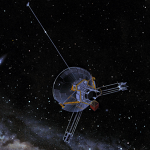
Pioneer 10 Crosses Neptune: Humanity Leaves the Solar System
Pioneer 10 crossed Neptune's orbit on June 13, 1983, becoming the first human-made object to travel beyond all known planets. At the time, Neptune was the outermost planet from the Sun because Pluto's eccentric orbit had carried it inside Neptune's path, a position it would hold until 1999. The spacecraft, launched from Cape Canaveral on March 2, 1972, had already achieved its primary mission by flying past Jupiter in December 1973 and returning the first close-up images of the gas giant. NASA designed Pioneer 10 for a twenty-one-month mission. The spacecraft carried eleven scientific instruments to measure radiation, magnetic fields, and charged particles, along with a gold-anodized aluminum plaque designed by Carl Sagan and Frank Drake showing a man and woman, the spacecraft's trajectory, and Earth's position relative to fourteen pulsars. The plaque was intended as a message to any extraterrestrial civilization that might encounter the craft millions of years in the future. Pioneer 10's journey through Jupiter's intense radiation belts nearly destroyed its electronics, but the spacecraft survived and transmitted data that revolutionized understanding of the solar system's largest planet. Scientists discovered that Jupiter radiates more heat than it receives from the Sun, mapped its enormous magnetosphere, and captured detailed images of the Great Red Spot and the Galilean moons. After passing Neptune's orbit, Pioneer 10 continued transmitting increasingly faint signals as its plutonium-238 power source decayed. NASA received the last detectable signal on January 23, 2003, when the spacecraft was approximately 7.6 billion miles from Earth. Pioneer 10 is now heading in the general direction of the star Aldebaran in the constellation Taurus, which it will reach in approximately two million years.
June 13, 1983
43 years ago
Key Figures & Places
What Else Happened on June 13
Two emperors who hated each other agreed on exactly one thing. Constantine and Licinius met in Milan in February 313, sealed a political marriage, and hammered …
He left home at 21 thinking he'd be back in a year. Ibn Battuta never returned. What started as a hajj to Mecca stretched into 75,000 miles across 44 modern cou…
The oldest military alliance still active today wasn't forged by grand diplomacy — it started as a transaction. England needed wool trade routes. Portugal neede…
Angry mobs led by Wat Tyler stormed and incinerated the Savoy Palace, the opulent London residence of John of Gaunt. By destroying the symbol of royal corruptio…
Henry VIII built the biggest warship on Earth and named it after God. Henry Grace à Dieu — "Henry, Grace of God" — wasn't subtle. At 1,500 tons and carrying 186…
Martin Luther married Katharina von Bora on June 13, 1525, in a ceremony at the Black Cloister in Wittenberg, directly defying the Roman Catholic Church's celib…
Talk to History
Have a conversation with historical figures who witnessed this era. Ask questions, explore perspectives, and bring history to life.