Aaron Burr Arrested: Former VP Charged with Treason
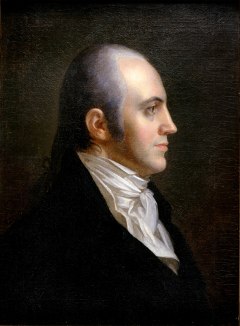
The former Vice President of the United States was arrested in the Alabama wilderness on February 19, 1807, disguised in rough frontier clothing and traveling with a small band of armed men toward Spanish Florida. Aaron Burr, who had killed Alexander Hamilton in a duel less than three years earlier and left office under a cloud of disgrace, was charged with treason for allegedly plotting to separate the western territories from the United States and establish his own empire. The conspiracy — if it was a conspiracy — remains one of the most bizarre episodes in early American history. Burr’s fall from power had been spectacular. He served as Thomas Jefferson’s vice president from 1801 to 1805, but the two men despised each other. When Jefferson dropped Burr from the 1804 ticket, Burr ran for governor of New York and lost, partly due to Hamilton’s opposition. The duel at Weehawken on July 11, 1804, killed Hamilton and destroyed Burr’s political career. Indicted for murder in both New York and New Jersey, Burr finished his term as vice president — presiding over the Senate while technically a fugitive — then headed west. What Burr actually planned in the western territories has never been definitively established. He recruited men, bought supplies, and built boats on the Ohio and Mississippi Rivers. He met repeatedly with General James Wilkinson, the commanding general of the US Army, who was secretly on the Spanish payroll. Burr may have planned to invade Spanish Mexico, or to detach the western states, or some combination. Wilkinson, fearing exposure, betrayed Burr to Jefferson, who ordered his arrest. Burr’s trial in Richmond, Virginia, presided over by Chief Justice John Marshall, became a constitutional landmark. Marshall defined treason narrowly, requiring proof of an overt act of war witnessed by two people. The prosecution could not meet this standard. Burr was acquitted on September 1, 1807, but his reputation was finished. He fled to Europe, spent four years trying to interest Napoleon in schemes to conquer Florida and Mexico, and returned to New York in 1812 to practice law in obscurity. The man who came within one electoral vote of the presidency died in a Staten Island boardinghouse in 1836, having demonstrated that in the early republic, ambition without boundaries could destroy even the most talented politician.
February 19, 1807
219 years ago
Key Figures & Places

What Else Happened on February 19
Septimius Severus and Clodius Albinus each brought approximately 150,000 soldiers to the field at Lugdunum (modern Lyon, France) in February 197 AD, producing t…
Constantius II ordered every pagan temple in the Roman Empire shut in 356. Not destroyed — closed. The difference mattered. Priests couldn't perform sacrifices.…
Constantius II banned pagan worship in 356, but he couldn't ban the temples themselves. Too many. Too expensive to destroy. So Romans kept visiting them — not t…
Boniface III waited eight months to become pope. The longest gap between popes in the church's first thousand years. He needed approval from Constantinople — th…
Sigismund III of the House of Vasa was crowned King of Sweden on February 19, 1594, making him the only person in European history to simultaneously rule both S…
Huaynaputina erupted with such force in 1600 that it ejected enough ash to bury nearby villages and trigger a global volcanic winter. The resulting drop in temp…
Talk to History
Have a conversation with historical figures who witnessed this era. Ask questions, explore perspectives, and bring history to life.