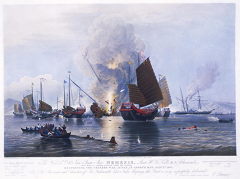
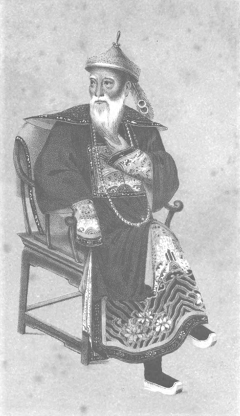
Lin Tse-hsü Destroys Opium: China's War Begins
Twenty thousand chests of opium, approximately 1,210 metric tons, were dissolved in trenches of water, salt, and lime on the beach at Humen near Canton on June 3, 1839. Imperial Commissioner Lin Zexu had confiscated the drug from British and American merchants after a six-week standoff, and now he supervised its destruction in a process that took twenty-three days. Workers flushed the dissolved narcotic into the sea at each high tide. Lin reportedly apologized to the ocean creatures for the pollution. The opium trade had created a public health catastrophe in China. British merchants, primarily operating through the East India Company, had been smuggling Indian-grown opium into China for decades to offset a massive trade deficit. Britain bought enormous quantities of Chinese tea, silk, and porcelain but produced almost nothing the Chinese wanted in return. Opium reversed the flow of silver. By the 1830s, an estimated two million Chinese were addicted, and the drain on the treasury alarmed the Qing court enough to send Lin, one of the empire’s most capable officials, to Canton with orders to end the trade. Lin’s seizure of the opium was legal under Chinese law. He gave the merchants a deadline to surrender their stocks, blockaded the foreign trading post when they refused, and waited them out. The British superintendent, Charles Elliot, eventually ordered the merchants to comply, promising that the Crown would compensate them. That promise converted a dispute between Chinese authorities and private drug dealers into a conflict between sovereign nations. Britain declared war in 1840. The First Opium War lasted two years and ended with the Treaty of Nanking, which ceded Hong Kong to Britain, opened five Chinese ports to foreign trade, and imposed an indemnity of 21 million silver dollars. Lin was exiled to the frontier. The treaty system that followed hollowed out Chinese sovereignty for a century.
June 3, 1839
187 years ago
Key Figures & Places

What Else Happened on June 3
Gladiators stormed the gates of Rome on June 3, 350 AD, and for 28 days that was actually enough to seize power. Flavius Popilius Nepotianus, a nephew of Empero…
Philippicus never saw it coming — literally. The Opsikion soldiers who seized him in Thrace didn't just remove him from power; they gouged out his eyes, the Byz…
Crusaders breached the walls of Antioch after an exhausting eight-month siege, ending months of starvation and stalemate. This victory secured a vital foothold …
Antioch didn't fall to swords — it fell to a traitor. A Armenian tower guard named Firouz, bitter over a cheese dispute with his commander, secretly opened the …
The Council of Sens condemned Peter Abelard’s theological writings as heretical after Bernard of Clairvaux successfully campaigned against his rationalist appro…
Norway and the Novgorod Republic formalized their northern frontier in Finnmark, ending decades of violent territorial skirmishes over tax collection rights. By…
Talk to History
Have a conversation with historical figures who witnessed this era. Ask questions, explore perspectives, and bring history to life.