Lexington and Concord: First Shots of the Revolution
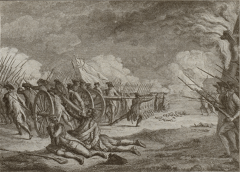
Seventy-seven colonial militiamen stood on Lexington Green in the gray light of April 19, 1775, watching 700 British regulars march toward them in column formation. Captain John Parker's order to his outnumbered men, "Stand your ground. Don't fire unless fired upon. But if they mean to have a war, let it begin here," was either the bravest or the most foolish command given that day. A shot rang out from an unknown weapon, British soldiers fired a volley without orders, and eight militiamen lay dead on the green. The American Revolution had begun. The British column, commanded by Lieutenant Colonel Francis Smith with Major John Pitcairn leading the advance, continued to Concord, where they searched for colonial military supplies. Most of the stores had already been moved, warned by the alarm riders the night before. At the North Bridge, a growing force of militia from surrounding towns confronted a British detachment. This time the Americans fired, killing three regulars and two officers in a volley that Ralph Waldo Emerson would later call "the shot heard round the world." The march back to Boston became a sixteen-mile running battle that the British barely survived. Militia companies from two dozen towns lined the road behind stone walls, fences, and trees, firing into the packed red column from both sides. The disciplined volleys that had scattered Parker's men at Lexington were useless against an enemy that fought from cover and melted away before bayonet charges. British casualties mounted with every mile. Only the arrival of a relief column under Lord Hugh Percy with artillery and 1,000 fresh troops prevented the complete destruction of Smith's command. By nightfall, 73 British soldiers were dead, 174 wounded, and 26 missing. American losses were 49 killed and 39 wounded. The battle transformed what had been a political dispute into an armed conflict. Within days, 15,000 militiamen from across New England had converged on Boston, trapping the British garrison in a siege that would last until March 1776. News of Lexington and Concord spread through the colonies within weeks, and each retelling hardened the conviction that reconciliation with Britain was no longer possible.
April 19, 1775
251 years ago
Key Figures & Places
What Else Happened on April 19
A slave named Milichus didn't just overhear a whisper; he heard his master Piso plotting to kill Nero himself. The freedman raced through Rome's dark streets, r…
Belisarius didn't just lose; he lost his cavalry to a Persian arrow that shattered his shield and forced a chaotic retreat across the Euphrates. Thousands of me…
Danish raiders bludgeoned the Archbishop of Canterbury, Ælfheah, to death after he refused to authorize a massive ransom payment from his impoverished people. H…
Three days of fire and blood in April 1506 turned Lisbon's streets red. Angry mobs dragged the "New Christians" from their homes, burning them alive at the Ross…
Seven German princes and four free cities just refused to sign a decree banning Luther's teachings. They didn't care that Emperor Charles V had already crushed …
The Treaty of Frankfurt of 1539 gave German Protestants a temporary reprieve — 15 months during which Charles V agreed to pause enforcement of the Edict of Worm…
Talk to History
Have a conversation with historical figures who witnessed this era. Ask questions, explore perspectives, and bring history to life.