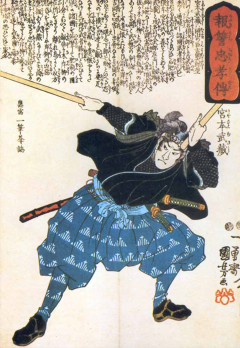
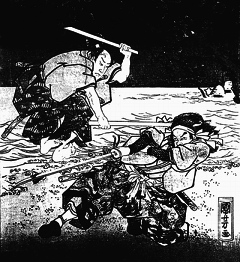
Musashi Defeats Kojirō: Birth of a Sword Master
Miyamoto Musashi arrived at Funajima (also called Ganryujima) island deliberately late on April 13, 1612, for his duel against Sasaki Kojiro, the most celebrated swordsman in Japan. Kojiro waited on the beach, increasingly agitated. Musashi had carved a wooden sword from a spare oar during the boat crossing. When he stepped ashore, Kojiro drew his famous long sword, the "Drying Pole." Musashi killed him with a single blow. The duel at Funajima was Musashi's most famous encounter and arguably the most storied single combat in Japanese history. He was approximately 28 years old. By his own account in The Book of Five Rings, written near the end of his life, he fought his first duel at thirteen and won over sixty more before retiring from dueling at age thirty. Born in Harima Province (modern Hyogo Prefecture) around 1584, Musashi grew up during the turbulent end of Japan's Sengoku period. He fought at the Battle of Sekigahara in 1600 on the losing side and spent the following decades as a ronin, a masterless samurai, wandering Japan and challenging swordsmanship schools. He developed niten ichi-ryu, a distinctive two-sword fighting style that used both the katana and the shorter wakizashi simultaneously. The style was considered unorthodox and was dismissed by traditionalists. Musashi's undefeated record silenced the critics. Kojiro was a master of the Ganryu school and was known for a technique called the "swallow cut," a sweeping overhead strike of devastating speed. The matchup between Kojiro's precision and Musashi's unorthodox approach captured the Japanese public imagination and has been retold in novels, films, manga, and television for four centuries. In his later years, Musashi settled in Kumamoto as a guest of the Hosokawa clan. He painted, practiced calligraphy, and wrote The Book of Five Rings, a treatise on strategy, combat, and philosophy that has been studied by martial artists and business strategists worldwide. He died in 1645, reportedly in a cave where he had retreated to write.
April 13, 1612
414 years ago
What Else Happened on April 13
Bishop Otto of Bamberg refused to hand over the imperial regalia until Henry V promised to stop appointing bishops without papal consent. For three days, the em…
Saladin routed the Zengid forces at the Battle of the Horns of Hama, consolidating his control over Syria from Damascus to the Euphrates with only Aleppo remain…
Crusaders breached the walls of Constantinople, systematically looting the city’s vast wealth and sacred relics. This brutal sack shattered the Byzantine Empire…
A storm sank the French fleet, trapping King Louis IX in the muddy streets of Damietta while his soldiers starved. He didn't just lose; he paid a massive ransom…
Pope Alexander IV just signed Licet ecclesiae catholicae to force scattered hermits into one order. Hundreds of men stopped sleeping in caves and started sharin…
A Prussian knight stabbed a Polish envoy in 1454, sparking a fight for Kneiphof that didn't end until 1466. Ten thousand souls starved while Teutonic knights an…
Talk to History
Have a conversation with historical figures who witnessed this era. Ask questions, explore perspectives, and bring history to life.