Hermitage Opens: Russian Art Goes Public
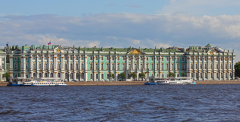
Catherine the Great started buying art to prove Russia belonged among Europe’s civilized powers. Nearly a century later, Tsar Nicholas I opened her collection to the public, creating one of the world’s great museums. The Hermitage Museum welcomed its first general visitors in 1852, granting ordinary Russians access to an imperial collection that had been the exclusive property of the ruling family since Catherine began acquiring masterworks in 1764. Catherine’s buying spree was legendary and strategic. She purchased entire collections wholesale, including 225 paintings from the Berlin merchant Johann Ernst Gotzkowsky in 1764, 600 paintings from the collection of Count Heinrich von Bruhl in 1769, and 198 works from the famed Crozat collection in Paris in 1772, which included pieces by Raphael, Giorgione, Titian, and Rembrandt. She corresponded with Voltaire and Diderot, who served as her art agents in Paris. By the time of her death in 1796, the collection numbered roughly 4,000 paintings. Nicholas I commissioned the architect Leo von Klenze to design the New Hermitage, a purpose-built museum structure adjacent to the Winter Palace on the Neva River embankment in Saint Petersburg. The building featured granite atlantes at its entrance, skylit galleries, and climate-controlled rooms designed specifically for displaying art. When it opened on February 5, 1852, visitors had to observe a strict dress code and request tickets in advance through the Imperial Court office. The Hermitage survived revolution, siege, and ideology. After the Bolsheviks seized the Winter Palace in 1917, the Soviet government nationalized the collection and expanded it with confiscated private holdings. During the 900-day Siege of Leningrad in World War II, staff evacuated over a million objects to the Urals while curators continued to lecture in the empty galleries, pointing at the outlines where paintings had hung. Today the museum holds more than three million items across six buildings, making it one of the largest art collections on Earth.
February 5, 1852
174 years ago
Key Figures & Places

What Else Happened on February 5
The Roman Senate bestowed the title pater patriae upon Caesar Augustus, officially cementing his status as the father of his country. This honor transformed his…
An earthquake hit Pompeii seventeen years before Vesuvius buried it. The tremors knocked down temples, cracked aqueducts, and collapsed the forum. Intensity IX …
The earthquake hit Pompeii seventeen years before Vesuvius buried it. February 5, 62 AD. The forum collapsed. The Temple of Jupiter cracked open. Hundreds died …
An Lushan declared himself Emperor of China, shattering the stability of the Tang Dynasty and launching the brutal An Lushan Rebellion. This violent power grab …
An Lushan commanded 164,000 troops — nearly half the Tang Dynasty's entire army. The emperor had given him that power. Trusted him completely. An Lushan was a f…
Guy Foulques ascended to the papacy as Clement IV, inheriting a fractured Europe embroiled in the conflict between the Holy Roman Empire and the Angevin dynasty…
Talk to History
Have a conversation with historical figures who witnessed this era. Ask questions, explore perspectives, and bring history to life.