

Halley's Comet Returns: Closest Approach to Sun
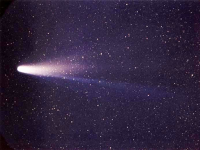
Halley’s Comet reached perihelion, its closest approach to the Sun, on February 9, 1986, traveling at 122,000 miles per hour on the return leg of a journey it has made roughly every seventy-five to seventy-nine years for at least two millennia. The 1986 apparition was the worst in recorded history for naked-eye observers. The comet was on the opposite side of the Sun from Earth during its brightest phase, making it a faint smudge barely visible without binoculars from most locations. Millions of people who had waited decades for the spectacle saw almost nothing. The comet that disappointed the public thrilled the scientific community. Five spacecraft from four nations intercepted Halley during its 1986 visit, the most ambitious fleet ever assembled for a single celestial target. The European Space Agency’s Giotto probe flew within 370 miles of the comet’s nucleus on March 14, 1986, returning the first close-up photographs of a cometary nucleus. The images revealed a dark, potato-shaped body roughly nine miles long and five miles wide, far darker than expected, reflecting only about 4 percent of incoming sunlight. Halley’s Comet occupies a unique place in human history. It is the only short-period comet regularly visible to the naked eye, and its appearances have been documented since at least 240 BC, when Chinese astronomers recorded it. The Bayeux Tapestry depicts its 1066 appearance as an omen of the Norman Conquest. Giotto di Bondone painted it as the Star of Bethlehem after observing its 1301 pass. Edmond Halley, studying Isaac Newton’s gravitational theory in 1705, recognized that comets observed in 1531, 1607, and 1682 were the same object and predicted its return in 1758. He died before seeing his prediction confirmed. The 1910 apparition had been spectacular, passing close to Earth and generating mass panic when astronomers detected cyanide compounds in the comet’s tail. Entrepreneurs sold anti-comet gas masks and "comet pills." The 1986 pass offered no such drama. Mark Twain, born during the 1835 apparition, had predicted he would "go out with the comet" and died one day after it returned in 1910. Halley’s next perihelion is expected around July 28, 2061.
February 9, 1986
40 years ago
Key Figures & Places

What Else Happened on February 9
Leo I needed an heir. His grandson was seven years old. So in 474, he crowned the boy's father — Zeno, an Isaurian chieftain from the mountains of southern Anat…
Bolesław I the Brave marched his forces into Bohemia to reinstall Boleslaus III as Duke, turning the region into a Polish satellite state. This intervention exp…
Bohemond of Taranto won the Battle of Antioch with an army that was starving. His Crusaders had been besieging the city for months, eating their horses, then th…
Chester's Roodee is the oldest racecourse still in use anywhere in the world. The first recorded race happened in 1539, run on a circular track around what used…
Bishop John Hooper endured three agonizing days of burning at the stake in Gloucester for refusing to renounce his Protestant convictions under Queen Mary I. Hi…
Gregory XV ascended to the papacy through acclamation, the final time the College of Cardinals bypassed a formal ballot to reach a unanimous decision. This shif…
Talk to History
Have a conversation with historical figures who witnessed this era. Ask questions, explore perspectives, and bring history to life.