Baltimore Burns: 1,500 Buildings Destroyed in 30 Hours
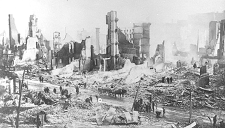
The Great Baltimore Fire burned for thirty straight hours starting on February 7, 1904, and destroyed 1,545 buildings across seventy blocks of the city’s business district. The blaze caused an estimated $150 million in damage, roughly $5 billion in today’s dollars. But the fire’s most consequential lesson had nothing to do with Baltimore itself: fire departments from Washington, Philadelphia, New York, Wilmington, and other cities rushed to help, only to discover that their hoses could not connect to Baltimore’s hydrants. Every city used different coupling sizes. The fire started around 10:48 a.m. on a Sunday in the basement of the John E. Hurst & Company dry goods warehouse on Hopkins Place. The exact cause was never determined, though a discarded cigarette or faulty electrical wiring were suspected. A brisk southwest wind fanned the flames through the densely packed commercial district, jumping from building to building across narrow streets. Baltimore’s fire department, though competent, was quickly overwhelmed. Mutual aid requests went out by telegraph. Fire companies from surrounding cities loaded their equipment onto trains and arrived within hours. The scene that greeted them was devastating: not because of the scale of the fire, which was enormous, but because their equipment was physically incompatible with Baltimore’s infrastructure. Firefighters from different cities stood watching helplessly as their colleagues struggled to connect hoses to hydrants using improvised adapters. The fire burned until it hit the Jones Falls waterway on the east, which served as a natural firebreak. Remarkably, no one died in the fire, partly because it started on a Sunday when the commercial district was largely empty. Baltimore rebuilt within two years, widening streets and adopting fire-resistant construction. The incompatible hose coupling disaster led to a national movement for standardization. The National Fire Protection Association accelerated its work on uniform equipment standards, and by 1905 most major American cities had begun adopting compatible hydrant connections. The fire proved that a crisis shared between cities requires infrastructure that works across borders.
February 7, 1904
122 years ago
Key Figures & Places
What Else Happened on February 7
Leo I became emperor because the army couldn't agree on anyone. So they asked Aspar, a barbarian general who couldn't legally take the throne himself. He picked…
Leo I became emperor because the army commander didn't want the job. Aspar, an Alan general who effectively ran the Eastern Roman Empire, couldn't take the thro…
Two of Basil II's best generals turned on him at once. Bardas Phokas the Younger and Bardas Skleros — both from military aristocracy, both commanding armies, bo…
Pandulf IV of Benevento fell in battle against invading Norman forces at Montesarchio, ending his long, turbulent reign as the Prince of Benevento. His death cl…
Mongol forces razed the city of Vladimir, systematically slaughtering the inhabitants and incinerating the Cathedral of the Assumption. This brutal conquest sha…
Anti-Unionist clergy gathered at the Blachernae synod to formally condemn the former patriarch John XI of Constantinople for his support of the Council of Lyon.…
Talk to History
Have a conversation with historical figures who witnessed this era. Ask questions, explore perspectives, and bring history to life.